

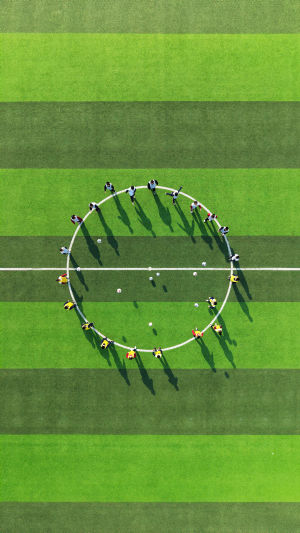
The first time you notice it, it feels chaotic. A defender takes a touch, and suddenly two opponents are already closing in.
There's no space to breathe, no easy pass back. What looks like panic is actually planning. Football tactics didn't jump here overnight.
They evolved slowly, from neat chalkboard shapes to systems built on pressure, timing, and collective movement.
<h3>When formations ruled everything</h3>
<b>Clear roles</b>, <b>Fixed zones</b>, <b>Predictable patterns</b>
Early football tactics were all about structure. Teams lined up in clear shapes like 4-4-2 or 3-5-2, and each player had a defined area to protect or occupy. Fullbacks stayed wide, midfielders held their lanes, and strikers waited for service.
Coaches focused on balance. If two players moved forward, two stayed back. This made teams easier to organize and easier to coach. Matches often unfolded at a steady pace. Players recycled possession until a clear opening appeared.
An actionable takeaway for players today: learn one position deeply first. Understanding spacing and discipline builds a base you'll use in any modern system. This era valued order. If you watched closely, you could almost draw the team's shape in your head as the ball moved.
<h3>The shift toward flexibility</h3>
<b>Fluid movement</b>, <b>Shared duties</b>, <b>Constant rotation</b>
As players became faster and fitter, rigid lines started to loosen. Coaches realized that keeping players locked in zones made teams predictable. Midfielders began drifting wide, fullbacks overlapped, and forwards dropped deeper.
A 4-3-3 could look like a 3-2-5 in possession, then snap back when the ball is lost.
Players are trained to read moments instead of memorizing positions.
Try this in training: rotate roles during small-sided games. Let defenders step into midfield and midfielders cover wide areas. It builds awareness and trust.
This flexibility laid the groundwork for pressing. You can't press well if players don't understand each other's movements.
<h3>Why high pressing changed everything</h3>
<b>Less time</b>, <b>Smaller gaps</b>, <b>Faster decisions</b>
High pressing isn't about running nonstop. It's about choosing the right moment to close space as a unit. Instead of waiting deep, teams defend from the front, forcing mistakes closer to the opponent's goal.
Pressing starts with triggers. A poor first touch or a pass toward the sideline signals the group to move.
Distances matter. If one player presses alone, the system collapses.
Actionable step: count three seconds. When possession is lost, the nearest players press immediately for three seconds before dropping back. This simple rule sharpens reactions.
High pressing flipped the idea of defense. Stopping attacks became a shared responsibility, not just a back-line task.
<h3>The role of fitness and recovery</h3>
<b>Short bursts</b>, <b>Smart pacing</b>, <b>Planned rest</b>
Pressing demands energy, but modern tactics don't rely on endless running. Instead, teams train for repeated short sprints and quick recovery.
Sessions now focus on intensity rather than duration.
Players track effort levels so they know when to push and when to slow the tempo.
Practical example: break training into four-minute drills with one-minute rest. It mirrors the rhythm of pressing phases in real matches.
Without this physical foundation, high pressing becomes risky and unsustainable.
<h3>How pressing reshaped player roles</h3>
<b>Active forwards</b>, <b>Brave defenders</b>, <b>Alert goalkeepers</b>
Modern pressing changed expectations across the pitch. Forwards defend, defenders step higher, and goalkeepers act as extra passers.
A forward's first job is now to block passing lanes, not just wait to score.
Defenders must stay comfortable with space behind them.
Try this drill: play with a high defensive line and limit back passes. It forces communication and quick decision-making.
Every role expanded. Football became more collective, with fewer passengers and more thinkers.
The beauty of tactical evolution is that it never really stops. What started as fixed shapes turned into moving systems, and those systems now breathe with pressure and release.
When you watch a team press well, you're seeing years of ideas layered together. Next time the ball is won high up the pitch, notice how calm it looks. That calm is the result of structure, freedom, and timing finally working as one.


