

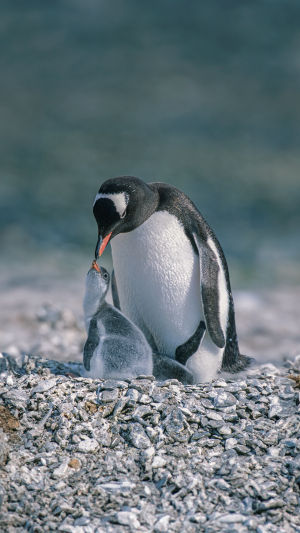
Let’s dive into the fascinating world of Gentoo penguins, scientifically known as Pygoscelis papua. These birds belong to the genus Pygoscelis, which also includes Adélie and Chinstrap penguins.
Some researchers even think Gentoo penguins might represent a species complex because they vary slightly depending on their region.
First described in 1781 by John Reinhold Foster in the Falkland Islands, these penguins are instantly recognizable by their bright orange bills, white head stripes, and lively personalities.
From the moment we see them, it’s clear that Gentoo penguins are full of energy. Their trumpet-like calls echo across the icy landscape, especially when they communicate with each other in large colonies. Observing them gives us a real sense of the busy and social lives they lead.
<h3>Where We Can Find Them</h3>
Gentoo penguins are mostly found in sub-Antarctic islands and along the northern Antarctic Peninsula. They prefer ice-free coastal areas where the ocean is nearby. Brown Bluff and the Falkland Islands are among the best-known colonies. These regions offer rocky terrain and small cliffs that provide safe nesting spots and protection from predators.
We also notice that Gentoos are adaptable. Some live on milder sub-Antarctic islands, while others thrive in colder Antarctic climates. Their ability to handle different environments allows us to see them in various landscapes, from snowy beaches to rugged rocks.
<h3>Daily Life and Feeding</h3>
One of the most impressive things we notice is how busy Gentoo penguins are. They spend hours swimming in the ocean, hunting for fish, squid, and krill. Unlike some penguins that hunt in large groups, Gentoos often fish alone or in small teams. We can watch them diving smoothly underwater, sometimes for minutes, as they skillfully chase prey.
On land, Gentoo penguins are just as active. They socialize constantly, exchanging loud trumpet-like calls that can be heard across the colony. During nesting season, we see them meticulously gathering stones for their nests. Parents take turns keeping the eggs warm, showing remarkable teamwork and care. Observing chicks hatching and learning to waddle around is one of the most heartwarming sights we experience.
<h3>Behavior and Communication</h3>
Watching their interactions, we quickly notice that Gentoo penguins are expressive and highly social. Each bird has a unique call, which helps parents locate their chicks even in crowded colonies. Alarmed penguins raise their heads, stretch their necks, and trumpet loudly to warn others of potential threats.
We also see playful behavior, like sliding across ice, chasing each other, or splashing in shallow water. These activities aren’t just for fun—they help them stay fit and strengthen social bonds. Being part of a Gentoo colony feels like witnessing a small, tightly knit community, where every penguin has a role to play.
<h3>Physical Adaptations</h3>
Gentoo penguins are perfectly built for survival. Their streamlined bodies and strong flippers allow them to swim quickly and dive up to 200 feet to catch food. Their bright orange bills and feet make them stand out against snowy landscapes, while their sharp claws allow them to grip ice and rocks safely. Even the white stripe across their head helps with recognition in large colonies.
We are amazed at how well they balance life on land and in water. Every feature, from their body shape to their vocal abilities, shows an incredible adaptation to harsh environments.
<h3>Conservation Status</h3>
Gentoo penguins are currently listed as “Least Concern” by the IUCN, but we shouldn’t be complacent. Their habitats face threats from climate change, overfishing, and human disturbance. Observing these penguins responsibly is crucial. By supporting local conservation programs, we help ensure that future generations can enjoy the lively, charming presence of Gentoo penguins in their natural homes.
<h3>Tips for Observing Gentoo Penguins</h3>
If we want to see Gentoo penguins in the wild, timing is important. The breeding season, from November to February, is ideal for witnessing chicks hatching and family interactions. Dressing warmly and wearing sturdy shoes is essential since rocky terrain can be slippery. We also need to keep a respectful distance so as not to disturb the birds.
Binoculars or a camera with a zoom lens let us capture the magic of their playful and social behavior safely.
<h3>Why We Love Gentoo Penguins</h3>
Lykkers, spending time watching Gentoo penguins reminds us why nature is full of surprises. Their playful personalities, strong family bonds, and adaptability make them unforgettable. Observing them gives us joy and a sense of connection to the wild. We leave Gentoo colonies feeling inspired, knowing that these vibrant birds continue to thrive despite the challenges of their icy world.
Gentoo penguin (Pygoscelis papua)
Video by A to Z Animals & Plants


