

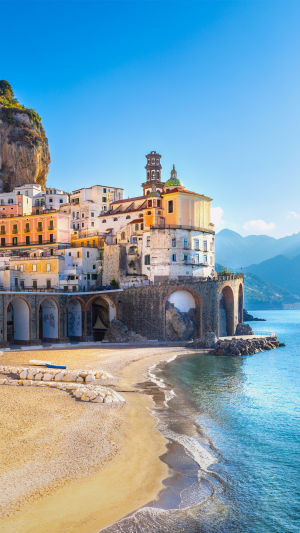
The first thing you feel in Amalfi isn't the view—it's the stairs. Stone steps warm underfoot, scooters humming past too close, sea air mixing with the smell of citrus drifting down from somewhere above.
By the time you stop to catch your breath, you're already looking back at the harbor from a height you didn't expect. Amalfi doesn't open itself all at once. It reveals itself in layers, and only if you slow down enough to notice.
Set along a steep stretch of Italy's southern coast, Amalfi is often treated as a quick stop. People arrive by ferry, walk the main street, take a photo, and leave. What they miss is that the city's real landscape isn't flat or central—it's vertical, fragmented, and shaped by movement on foot.
<h3>How Amalfi is actually meant to be used</h3>
Amalfi isn't designed for efficient sightseeing. The town sits in a narrow valley, squeezed between cliffs and water. Roads are tight, pedestrian space is limited, and vehicle traffic never really pauses. This creates a natural constraint: moving slowly on foot is often faster and calmer than trying to shortcut by car or bus.
Because access is limited and streets climb sharply, people who stay low tend to cluster. Those who walk upward—into stairways, terraces, and side paths—experience a different rhythm entirely. Crowds thin out, sounds soften, and the town starts to feel residential rather than performative.
The key shift is mental. Amalfi works best when treated less like a destination and more like a slope you move through gradually.
<h3>Getting in and moving around</h3>
Most travelers arrive by ferry or regional bus. Both drop you near the harbor, which is also the busiest part of town.
<b>Ferry access:</b> seasonal routes from nearby coastal towns
<b>Bus access:</b> regional buses stop near the main square
<b>Walking conditions:</b> steep stairs, uneven stone paths
<b>Car access:</b> limited, slow, and often frustrating
Once you arrive, walking becomes the most reliable option. Even short distances involve elevation changes, so plan fewer stops and allow extra time. Comfortable shoes matter more here than almost anywhere else on the coast.
<h3>Timing the landscape, not the sights</h3>
Amalfi's landscape changes dramatically depending on the hour. Light, sound, and foot traffic all shift in noticeable ways.
Before 9:00 a.m., delivery carts move through the main street and locals outnumber visitors. The sea is calmer, and the harbor feels functional rather than crowded. Between 10:30 a.m. and early afternoon, ferry arrivals compress the town into its narrowest points. Noise rises, walking slows, and patience wears thin.
Late afternoon brings relief. Day visitors leave, shadows stretch across the facades, and stairways cool enough to sit on. This is when Amalfi feels lived-in again.
<h3>Using height to your advantage</h3>
The most overlooked part of Amalfi's city landscape is elevation. Even climbing ten minutes above the main street changes perspective completely.
Walk uphill toward residential paths rather than chasing viewpoints marked on maps. Small terraces, laundry lines, and quiet corners offer better context than formal overlooks. You start to see how houses stack, how paths connect, and how daily life adapts to steep ground.
The effort pays off quickly. Fewer people follow, and the town's visual logic becomes clear: Amalfi isn't built around the sea alone, but around the space between rock and water.
<h3>Where to stay and what it changes</h3>
Where you sleep in Amalfi affects how you experience the landscape more than amenities ever will.
Staying close to the harbor is convenient for arrivals and departures, but it keeps you in the loudest, flattest zone. Noise carries late, and mornings start early.
Staying higher up means more stairs, but also quieter evenings and better airflow. You'll walk more, but you'll also exit and re-enter the town at calmer points, avoiding peak congestion.
The trade-off is clear: less effort means more noise, while more effort buys you space and calm.
<h3>Practical costs and access notes</h3>
Amalfi itself doesn't require entry tickets, but movement and timing still have practical costs.
<b>Ferry fares:</b> vary by route and season, typically $10–25 USD
<b>Local buses:</b> low cost but crowded during midday
<b>Public spaces:</b> free, limited seating
<b>Peak season:</b> late May through September
Planning around these constraints reduces friction. Arriving early and leaving late often costs the same but feels entirely different.
<h3>Local habits that make a difference</h3>
1. Walk uphill first, then descend later. Crowds move opposite to this flow, and gravity works in your favor by the afternoon.
2. Pause on stairs, not sidewalks. Stairs are part of daily life here, and stopping on flat paths blocks movement quickly.
3. Watch the harbor from above, not at sea level. Height shows how the town breathes as ferries arrive and depart.
Ignoring these habits usually turns Amalfi into a test of patience rather than a place to absorb.
<h3>When to leave the center</h3>
Amalfi's landscape doesn't end at the main square. Short coastal paths and inland walks connect to quieter zones within minutes. Leaving the center even briefly resets your sense of space.
A half-hour walk away from the harbor often brings silence, wider views, and a clearer understanding of how dramatic the terrain really is. Returning afterward makes the town feel smaller and easier to navigate.
As evening settles and lights flicker on across the stacked houses, Amalfi looks the way it feels best—layered, uneven, and calm enough to breathe. The landscape doesn't demand that you see everything. It simply asks how much effort you're willing to give. Will you stay low where it's easy, or climb just enough to see the city differently?


