

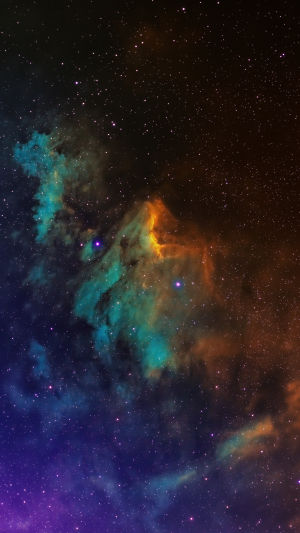
It's staggering to imagine the universe as it existed billions of years ago—a hot, dense, and chaotic sea of particles.
Yet, from this primordial chaos, the cosmos began forming vast structures that still puzzle scientists today.
Observing distant galaxies is like peering into a time machine, but even with the most advanced telescopes, some features of the early universe remain unexplained.
<h3>Tracing the Cosmic Web</h3>
The universe isn't a random scatter of galaxies; it forms an intricate cosmic web of filaments and voids.
<b>Why it matters:</b> Understanding these patterns helps scientists test theories of gravity, dark matter, and cosmic expansion.
<b>Key mystery:</b> Some filaments appear denser or more extended than simulations predict. Astronomers compare observations from telescopes such as the Hubble Space Telescope and the James Webb Space Telescope with cosmological models, yet some early structures—like dense galaxy groups or long cosmic filaments—still challenge expectations.
<b>Actionable example:</b> Astronomers map galaxy clusters using large redshift surveys and compare the observations with computer simulations. Cosmologist Marc Davis, who led major galaxy redshift surveys and worked on simulations of cosmic structure, used these methods to study how galaxies cluster across the universe. By comparing survey data with numerical models of dark matter, researchers can test different scenarios and refine our understanding of how the cosmic web and large-scale structures evolved over time.
<h3>Galaxy Formation Puzzles</h3>
Galaxies didn't form overnight. Gas clouds cooled, condensed, and merged over millions of years, but observations reveal surprises.
<b>Unexpected finds:</b> Some early galaxies are surprisingly massive, with mature structures appearing just a few hundred million years after the birth of the universe. This challenges current models of star formation and galaxy growth.
<b>Step-by-step approach:</b>
1. Identify high-redshift galaxies through deep-field imaging.
2. Analyze their light spectra to determine age, composition, and star formation rates.
3. Compare observations with predictions from galaxy evolution simulations.
This process often highlights gaps in our theories, prompting new hypotheses about rapid star formation or early mergers.
<h3>The Dark Matter Enigma</h3>
Dark matter remains invisible, yet it shapes everything in the universe. Its influence in the early cosmos is critical but elusive.
<b>Core issue:</b> Some structures form in ways that suggest either an unexpected distribution of dark matter or interactions we don't yet understand.
<b>Actionable example:</b> Scientists use gravitational lensing—where massive objects bend light—to infer the presence and distribution of dark matter. Cosmologist Rachel Mandelbaum has used weak gravitational lensing of galaxies to study the distribution of dark matter and test cosmological models. By mapping these subtle distortions across millions of galaxies, researchers can compare observations with theoretical predictions to determine whether current dark-matter models match the structure of the early universe.
<h3>Cosmic Microwave Background Clues</h3>
The cosmic microwave background (CMB) is the afterglow of the universe's beginning, offering a snapshot of the universe when it was just 380,000 years old.
<b>Why it's puzzling:</b> Tiny temperature fluctuations in the CMB hint at the seeds of all large-scale structures, yet some anomalies don't fit standard inflationary models.
<b>Step-by-step guidance:</b>
1. Collect precise measurements from satellites like Planck.
2. Analyze the spectrum of fluctuations for deviations from predicted patterns.
3. Test new cosmological models or variations in inflation to explain these anomalies.
These subtle clues may unlock deeper secrets about the universe's earliest moments.
<h3>Early Star Clusters and Metallicity</h3>
Stars in the first few hundred million years had extremely low metallicity—meaning they contained almost no elements heavier than hydrogen and helium.
<b>Observation challenge:</b> Some star clusters appear more chemically evolved than expected for their age.
<b>Actionable example:</b> Astronomers study stellar populations in distant galaxies using spectroscopy. By analyzing elemental abundances, they can trace back star formation histories and adjust theories on how quickly metals spread through the cosmos.
Peering into the early universe is like assembling a puzzle without knowing what the pieces look like. Every new observation reshapes our understanding, revealing both the brilliance and complexity of cosmic evolution.
While many mysteries remain, each clue brings us closer to understanding how the universe we inhabit emerged from its chaotic beginnings. Observing the distant cosmos isn't just about looking back in time—it's about learning the story of existence itself.


