

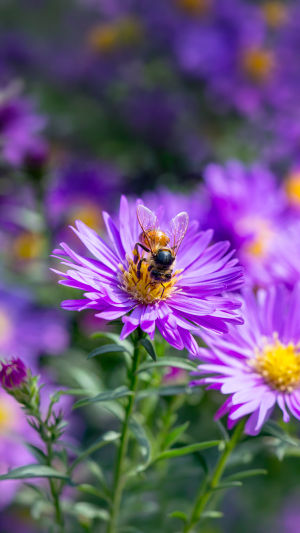
Have you ever watched a bee hover over a flower and wondered what's really happening inside that tiny brain?
What if those rapid movements are not just instinct, but a form of decision-making far more complex than we assumed?
Recent research suggests that possibility is real, and it reshapes how we understand one of nature's most essential pollinators.
In a remote valley in northern New Mexico, beekeeping life continues against a backdrop of seasonal hardship. Stacks of wooden hives sit beside firewood piles, carefully sealed with resin as colonies prepare for colder months. Inside, a structured society continues working with precision, centered around a queen who anchors the entire system.
Yet globally, bee populations are under pressure. Disease, parasites, chemicals, and habitat loss have caused severe declines in many regions. Since bees are responsible for pollinating a large share of flowering plants and food crops, their decline raises serious ecological concerns. While honeybees are the most visible, thousands of wild species—solitary and social—play equally important roles in sustaining ecosystems.
<h3>Smarter Than We Thought</h3>
For a long time, bees were treated as instinct-driven insects, behaving through fixed biological programming. That view is now changing.
Experimental studies show bees can navigate complex environments using memory, sunlight orientation, and learned experience. They can associate colors with food rewards, adjust flight paths based on changing conditions, and even optimize routes across unfamiliar terrain.
In carefully designed experiments, bees demonstrated something unexpected: numerical awareness. When trained to find food placed between visual markers, they were able to consistently identify the correct location even after the setup changed. This suggests a level of abstraction previously not attributed to insects.
<h3>Problem Solvers in Action</h3>
Researchers have gone further, designing tasks that test flexible thinking. In one study, bees learned to pull a string to move an object and access a reward. Even more striking, bees that had not been trained directly were able to learn by observing others. The behavior spread through groups, indicating social learning rather than simple conditioning.
In another experiment, bees were challenged to move objects toward a target in order to obtain nectar. Some individuals solved the task without prior instruction, suggesting they could form a goal and discover a solution independently rather than relying only on trial and error.
These results point to cognitive flexibility, meaning bees can adapt behavior to new and unexpected problems.
<h3>Do Bees Feel?</h3>
As evidence of intelligence increases, researchers have begun exploring a more complex question: can bees experience emotional-like states?
When exposed to simulated threats, bees became more cautious and selective, carefully inspecting flowers before landing. When presented with unexpected rewards, they showed more exploratory and optimistic behavior.
While this does not imply human-like emotional reflection, it suggests bees respond to experiences in ways that resemble patterns associated with fear, caution, and positive expectation.
<h3>Engineers of the Natural World</h3>
Bees also demonstrate extraordinary building abilities, with strategies that vary across species.
<b>1. Diggers:</b> create underground tunnels with protected chambers
<b>2. Carpenters:</b> excavate wood or plant stems using strong jaws
<b>3. Renters:</b> occupy existing natural or abandoned spaces
<b>4. Builders:</b> construct structured hives collectively
Even solitary species, which live only briefly, are capable of designing highly efficient nesting systems adapted to their environments.
<h3>Adapting to a Changing World</h3>
Some researchers and beekeepers are shifting away from heavy chemical intervention and instead focusing on breeding colonies that can survive on their own strengths. The idea is to encourage resilience rather than dependency.
At the same time, scientists are tracking bee movement in natural environments to understand how they respond to shifting landscapes, weather changes, and food availability. These findings are increasingly used in agriculture and conservation planning.
<h3>A Lesson for Humans</h3>
The growing body of research makes one thing clear: bees are far more capable than once believed. They are not simple automatons, but adaptive learners capable of solving problems, communicating, and responding to their environment in complex ways.
So next time you see a bee moving from flower to flower, consider this: are we witnessing instinct alone, or something closer to intelligence in action?
And perhaps the deeper question is not how bees survive in our world—but how we might better understand the world they have been shaping all along.


