

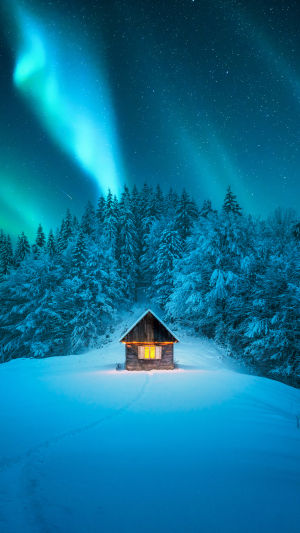
The window of a wooden cabin glows amber against a landscape that has turned entirely blue. Outside, the temperature sits somewhere below minus twenty. The forest is completely still
The snow is deep enough that footprints from earlier in the evening have already begun to fill in. And then, without warning, the sky begins to move — a ribbon of green light appears above the treeline, widens, shifts, and spreads across the entire upper half of the sky in a display that no photograph has ever adequately prepared anyone to witness in person.
Finnish Lapland delivers this experience with a consistency that nowhere else in the Northern Lights belt quite matches. The combination of extreme darkness in winter, minimal light pollution, reliable snowfall, and an established infrastructure of wilderness accommodation makes this the most practical destination in the world for aurora hunting — and the most atmospheric place to do it from the warmth of a private cabin in a forest clearing.
Lapland
<h3>Where Exactly in Lapland to Go</h3>
Finnish Lapland covers the entire northern third of Finland above the Arctic Circle. The main destination centers are Rovaniemi — the regional capital, located right on the Arctic Circle line — and the more northerly wilderness areas around Saariselkä, Inari, and Levi.
Rovaniemi is the most accessible entry point and suits visitors who want a mix of aurora viewing, husky safaris, and snowmobile excursions without venturing too deep into the wilderness. The aurora viewing from Rovaniemi itself is often compromised by light pollution from the town, which makes staying in accommodation outside the center significantly more rewarding.
Saariselkä, approximately 250 kilometers north of Rovaniemi, sits above the tree line in open fell country where the sky is visible in all directions simultaneously — the best configuration for catching aurora displays that appear unexpectedly at any compass point. The small resort village offers accommodation ranging from hotel rooms to private wilderness cabins without the congestion of Rovaniemi during peak season.
Inari, the most northerly of the main destinations at approximately 300 kilometers north of Rovaniemi, combines exceptional aurora conditions with access to the vast lake system of Lake Inari — a frozen expanse in winter that provides open sky horizons and the possibility of witnessing the lights reflected in the ice on clear nights.
<h3>Getting There</h3>
Rovaniemi Airport receives direct flights from Helsinki throughout winter, with Finnair operating multiple daily connections. The flight from Helsinki takes approximately one hour and fifteen minutes, with tickets starting from approximately $80 to $150 each way during winter season. Connections from other European capitals to Helsinki and onward to Rovaniemi are available from most major hubs.
For Saariselkä and Inari, the nearest airport is Ivalo Airport, approximately 40 kilometers from Saariselkä. Direct flights from Helsinki to Ivalo operate daily during winter, with tickets from approximately $100 to $180 each way. Car rental at Ivalo Airport is available from approximately $60 to $90 per day for a standard vehicle — winter tires are fitted as standard to all rental vehicles in Lapland during the winter season, which runs from November through April.
Driving from Rovaniemi to Saariselkä takes approximately three hours on well-maintained Arctic roads. The drive itself passes through increasingly remote and beautiful winter landscape and is worthwhile for visitors with time and confidence driving in snow conditions.
<h3>Aurora Viewing — What Actually Improves Your Chances</h3>
The northern lights are a natural phenomenon that cannot be scheduled, but several factors significantly improve the probability of a sighting during any given trip.
1. Stay a minimum of five nights — aurora activity is variable and even in prime locations, cloudy nights can obscure displays. Five nights provides enough opportunities to catch at least one clear-sky display with meaningful activity.
2. Position yourself away from artificial light — even modest light pollution from a small village significantly reduces the visibility of fainter aurora activity. Wilderness cabin accommodation outside settlements offers a measurable advantage over hotel rooms in town centers.
3. Use the aurora forecast — the Finnish Meteorological Institute publishes a daily geomagnetic activity forecast. A Kp index of 3 or above is sufficient for strong aurora visibility at Lapland latitudes on clear nights. Kp 5 or above produces the dramatic, full-sky displays that fill the horizon.
4. Stay awake between 10 p.m. and 2 a.m. — peak aurora activity statistically concentrates around local midnight, though displays can occur at any hour after dark.
5. Sleep in accommodation with large north-facing windows or aurora alarm services — several Lapland properties offer wake-up calls when aurora activity is detected, allowing guests to sleep and still catch displays without maintaining a personal watch through the night.
<h3>Where to Stay</h3>
The accommodation that matches the atmosphere of a glowing cabin in a snow-covered forest clearing is available across a range of price points in Finnish Lapland.
Kakslauttanen Arctic Resort near Saariselkä is the most internationally recognized property in Lapland, famous for its glass igloo accommodation that allows aurora viewing from bed. Glass igloo rooms start from approximately $500 to $800 per night during peak season. Traditional log cabin accommodation at the same property starts from approximately $250 to $400 per night.
Wilderness Hotel Inari on the shores of Lake Inari offers aurora cabin accommodation with private saunas from approximately $200 to $350 per night. The lakeside position provides open sky views over the frozen lake — one of the most atmospheric settings in all of Lapland for aurora observation.
For visitors managing costs, a range of self-catering cabin properties throughout the Saariselkä area offers private wilderness cabin accommodation from approximately $100 to $180 per night — smaller and less designed than the premium properties, but positioned in genuine forest wilderness with the same aurora viewing potential and considerably more solitude.
Finnish Lapland in winter delivers something that very few travel experiences can honestly promise — a combination of extreme natural beauty, complete darkness, and a phenomenon overhead that has no equivalent anywhere in ordinary life. The glowing cabin window, the snow-covered trees, the lights moving across the sky above — these are not embellishments of the experience. They are the experience, exactly as it happens, for anyone who arrives at the right latitude and stays long enough to find a clear night.


