

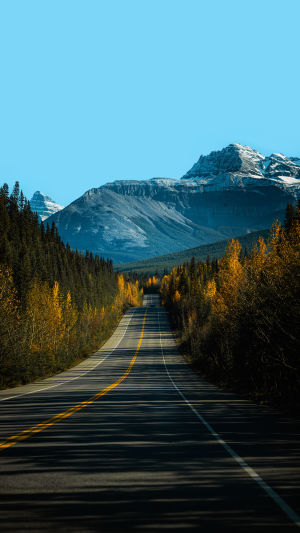
The road ahead runs perfectly straight for several kilometers before curving gently left and disappearing into a wall of golden aspen and dark spruce. Snow sits on the peaks above the treeline. The sky is the specific deep blue that only appears at altitude on clear autumn mornings.
There is no traffic in either direction. The only sound is the engine and, when you roll the window down, the wind moving through the trees. This is the Icefields Parkway in early autumn — and it is one of the most straightforwardly beautiful driving experiences available anywhere in the world.
The Icefields Parkway, officially designated Highway 93 North, runs 232 kilometers between Lake Louise in Banff National Park and the town of Jasper in Jasper National Park through the heart of the Canadian Rockies. It passes glaciers, turquoise lakes, waterfalls, canyon viewpoints, and wildlife corridors in a concentration that makes most other scenic drives look understated by comparison. The entire route sits within protected national park land on both sides, which means the landscape visible from the road looks essentially the same as it did a century ago.
Icefields Pkwy
<h3>When to Drive It and Why Autumn Is the Best Answer</h3>
The Icefields Parkway is driveable year-round, but the experience changes dramatically with season. Summer brings the most visitors — July and August see heavy traffic, crowded pullouts, and the need to arrive at popular viewpoints before 8 a.m. to find parking. Winter closes some sections temporarily and requires winter tires, but rewards those prepared for it with empty roads and dramatic snow-covered scenery.
Autumn — specifically late September through mid-October — represents the clearest argument for timing a visit carefully. The aspen and larch trees that grow in the valley bottoms and on the lower mountain slopes turn gold during this window, creating the contrast between warm amber foreground, dark green spruce middle ground, and grey and white mountain backdrop that the road is most famous for in photography. The crowds thin considerably after the summer peak. The air is cold enough to be sharp but not cold enough to close roads. Wildlife activity increases as animals move before the full onset of winter.
The western larch trees that grow at elevation on the slopes above Bow Lake and around the Num-Ti-Jah Lodge area reach peak color approximately two weeks after the valley aspens, which means a visit timed for early October often catches both simultaneously.
<h3>Getting There and Renting a Vehicle</h3>
The Icefields Parkway is best driven from south to north — starting at Lake Louise and ending in Jasper — as this direction puts the driver on the mountain side of the road for the most dramatic viewpoints and allows the journey to end in Jasper town, which has the widest range of accommodation and dining options at the road's terminus.
Calgary International Airport is the most practical entry point for a Rockies road trip, located approximately 180 kilometers east of Lake Louise via the Trans-Canada Highway. The drive from Calgary to Lake Louise takes approximately two hours. Car rental at Calgary Airport starts from approximately $60 to $90 per day for a standard vehicle during autumn season. A compact SUV or crossover is recommended over a sedan for comfort on the occasional gravel access roads leading to secondary viewpoints.
Alternatively, Edmonton International Airport — approximately 360 kilometers north of Jasper — allows the drive to be done in the opposite direction and may offer lower rental rates outside peak summer season.
A Canadian national park pass covering both Banff and Jasper is required to drive the Icefields Parkway. The Discovery Pass, valid for 12 months, costs approximately $75 per vehicle and covers all national parks in Canada. A single-day entry pass costs approximately $21 per vehicle.
<h3>Key Stops Along the Route</h3>
Driving the full 232-kilometer route without stopping takes approximately three hours. Most visitors spread the drive across a full day or two days with an overnight stop at the Columbia Icefield or in Jasper.
1. Bow Lake — located approximately 36 kilometers north of Lake Louise, Bow Lake is a glacially fed turquoise lake with the Bow Glacier visible at its upper end. A short flat walk along the lakeshore takes approximately 30 minutes and provides the most accessible glacier views on the southern section of the parkway. Free to access with park pass.
2. Peyto Lake Viewpoint — a 1.2-kilometer walk uphill from the Bow Summit parking area leads to an elevated viewpoint over Peyto Lake, whose wolf-head shape and brilliant turquoise color make it one of the most photographed lakes in Canada. Open year-round. No additional cost beyond park pass.
3. Columbia Icefield — the largest icefield in the Canadian Rockies, visible from the road at the parkway's midpoint. The Glacier Skywalk, a glass-floored observation platform cantilevered over the Sunwapta Valley, charges approximately $32 per person. Ice Explorer tours onto the Athabasca Glacier surface cost approximately $55 per person and run from spring through autumn.
4. Athabasca Falls — a powerful waterfall located 30 kilometers south of Jasper where the Athabasca River drops through a narrow quartzite canyon. The canyon is accessible via a short paved walking circuit of approximately 800 meters. Free with park pass.
5. Sunwapta Falls — twin waterfalls on the Sunwapta River, accessible via a 400-meter walk from the highway. The lower falls require an additional 1.6-kilometer walk through forest. Free with park pass.
<h3>Where to Stay Along the Route</h3>
Accommodation on the Icefields Parkway itself is limited to a small number of properties, which book out weeks to months in advance during autumn foliage season.
Num-Ti-Jah Lodge at Bow Lake is the most atmospheric property on the entire route — a historic red-roofed lodge sitting directly on the lakeshore with the Bow Glacier visible from the dining room windows. Rooms start from approximately $250 to $380 per night during autumn season. The location at the center of the golden larch zone makes it the ideal overnight stop for autumn foliage timing.
Columbia Icefield Glacier Discovery Centre has hotel-style rooms within the visitor complex at the parkway's midpoint, with rates from approximately $180 to $260 per night. The position directly across from the Athabasca Glacier allows guests to observe the icefield at dawn before the tour groups arrive.
In Jasper town at the northern terminus, the Fairmont Jasper Park Lodge offers full resort accommodation from approximately $350 to $600 per night. A range of independent hotels and guesthouses in Jasper provide comfortable rooms from approximately $120 to $220 per night within walking distance of the town's restaurants and the parkway's northern end.
The Icefields Parkway works best when treated as a destination in itself rather than a route between two points. The stops are the point. The light at 7 a.m. on Bow Lake is the point. The moment the road crests Bow Summit and the first glimpse of Peyto Lake appears through the trees is the point. Drive it slowly, stop often, and allow the route more time than the map suggests it needs. The Rockies will use every extra hour well.


