

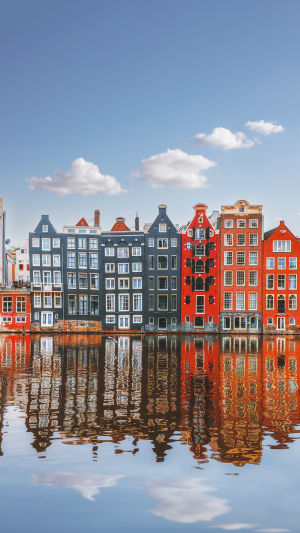
Seven narrow facades rise five and six stories from the water's edge, each one slightly different in color, gable shape, and angle of lean.
The reflections in the canal below duplicate the composition almost perfectly, the dark water turning the scene into a symmetrical image that looks too precisely composed to be accidental.
These are Amsterdam's canal houses on the Damrak, built during the Dutch Golden Age of the 17th century when this city was one of the wealthiest trading centers in the world, and they remain the most immediately recognizable streetscape in the Netherlands.
The canal house is not simply a building type. It is the product of a specific set of constraints that were unique to 17th-century Amsterdam. Land along the canals was taxed by facade width, which drove builders to make houses as narrow as possible while maximizing height. The result is the characteristic tall, thin proportions visible in every historic canal street in the city.
<h3>Why the Houses Lean Forward</h3>
The forward lean of Amsterdam's canal houses is not structural failure. It is deliberate design. Each house was built with a slight forward tilt so that furniture and goods being hoisted up the exterior using the beam hook visible at the top of each gable would clear the facade during the lifting process.
The beam and pulley system was the primary means of moving large items between floors in buildings whose internal staircases are too steep and narrow for furniture to pass through.
The lean also means that rain runs away from the facade rather than down the building's front face, protecting the timber-framed construction from water damage. Every element of the design responds to practical necessity rather than aesthetic preference, which is what makes the result so distinctive.
<h3>Getting There</h3>
Amsterdam is served by Schiphol Airport, one of Europe's busiest international hubs, with direct flights from cities across North America, Asia, and Europe. The airport train connects directly to Amsterdam Centraal station in approximately 15 minutes, with tickets costing approximately $5 to $7 per person.
The Damrak canal houses are a 5-minute walk from Amsterdam Centraal station, making them among the most accessible major landmarks in Europe. No transport is needed beyond arriving at the station.
Canal boat tours departing from the Damrak waterfront provide a water-level view of the canal houses that the street-level perspective cannot replicate. One-hour boat tours cost approximately $15 to $20 per person and operate throughout the day from multiple departure points along the Damrak.
Damrak
<h3>Key Experiences and Costs</h3>
The canal house district rewards exploration on foot and by bicycle, with the Damrak forming just one section of a much larger historic canal network.
1. The Amsterdam Museum of the Canals, housed in a former canal house on the Herengracht, covers the construction and social history of the canal ring. Entry costs approximately $15 per person. Open daily from 10 a.m. to 5 p.m.
2. The Anne Frank House on the Prinsengracht, where a local family hid for two years during the Second global conflict occupation, is Amsterdam's most visited museum. Entry costs approximately $16 per person and must be booked online in advance as walk-in entry is not available. Open daily from 9 a.m. to 10 p.m.
3. The Westerkerk tower climb, adjacent to the Anne Frank House, provides elevated views over the canal ring rooftops. Tower entry costs approximately $10 per person during the open season from spring through autumn.
4. Bicycle rental for exploring the wider canal ring independently costs approximately $12 to $18 per day from rental shops near Centraal station, providing the most efficient way to cover the full circuit of the UNESCO-listed canal district.
<h3>Where to Stay</h3>
Amsterdam's accommodation ranges from converted canal houses to large modern hotels, with canal house properties providing the most atmospheric experience of the city.
The Dylan Amsterdam on the Keizersgracht is a boutique hotel occupying a 17th-century canal house with rooms from approximately $280 to $450 per night. Pulitzer Amsterdam spans 25 connected canal houses on the Prinsengracht with rooms from approximately $200 to $380 per night, providing the most authentic canal house accommodation experience at scale.
Several smaller canal house hotels and guesthouses throughout the Jordaan neighborhood and the canal ring offer rooms from approximately $100 to $180 per night, combining historic building character with proximity to the main canal streets and the city's museum district.
Amsterdam's canal houses work best when approached slowly and from multiple angles. The street-level view from the bridge, the water-level view from a canal boat, and the elevated view from a tower each reveal different aspects of the same buildings. The Damrak houses in particular, with their varied gable profiles and the strong reflection they produce in calm morning water, deserve more than a passing photograph.
Arrive before 9 a.m. when the tour boats have not yet started and the reflection in the canal is unbroken, and the composition the 17th-century builders created will be entirely yours for at least half an hour.


