

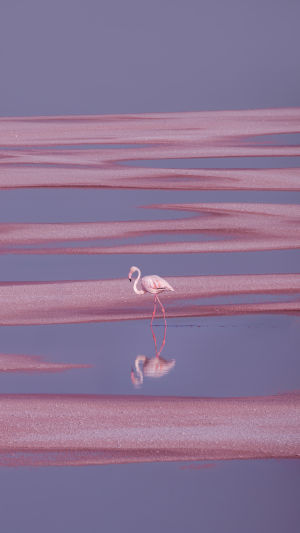
A shallow lake shimmers under sunlight, and suddenly the surface fills with a soft wave of pink movement. Long legs step slowly through the water, and curved necks dip in rhythm with feeding patterns.
These are flamingos, among the most visually striking birds in the natural world, known for a color that seems almost artificially painted—but it is entirely biological.
<h3>Where the Color Really Comes From</h3>
Flamingos are not born pink. In fact, chicks start with gray or white down feathers. Their color develops gradually through diet.
The key factor is a group of natural pigments called carotenoids, found in algae, plankton, and small crustaceans that flamingos consume. During digestion, these pigments are broken down and absorbed into the bird's body, eventually reaching the feathers.
Over time, this process transforms their appearance from pale tones into shades ranging from soft pink to deep coral.
<h3>Diet Shapes the Shade</h3>
The intensity of a flamingo's color depends directly on what it eats.
• Diet rich in algae leads to deeper coloration
• Crustacean-heavy feeding produces brighter tones
• Limited pigment intake results in paler feathers
This means color is not fixed—it changes gradually based on environment and food availability.
<h3>Feeding in Unique Environments</h3>
Flamingos often inhabit shallow lakes and lagoons with high mineral content. These environments support microorganisms that form the base of their diet.
Their feeding technique is highly specialized. They invert their heads and filter water through their beaks, trapping tiny food particles while expelling excess water. This method allows them to efficiently extract nutrients from dense, shallow habitats.
<h3>Social Structure in Large Groups</h3>
Flamingos are highly social birds and typically live in large colonies. These groups can range from dozens to thousands of individuals.
• Group living improves protection from predators
• Synchronized movements reduce individual risk
• Collective nesting increases reproductive success
The coordinated behavior within colonies creates a visually dynamic environment where movement and color appear almost rhythmic.
<h3>Why Standing on One Leg?</h3>
One of the most recognizable flamingo behaviors is standing on one leg. This posture is not just aesthetic—it serves practical purposes.
It helps reduce muscle fatigue by allowing alternating leg rest, and may also assist in conserving body heat when standing in cooler water. The behavior is stable enough that flamingos can even rest while maintaining balance in this position.
<h3>Adaptation to Harsh Conditions</h3>
Flamingos thrive in environments that many other species avoid. Their preferred habitats often have high salinity or alkalinity, where few predators or competitors exist.
Their physiology is adapted to filter and process mineral-rich water, allowing them to occupy ecological niches with limited competition.
<h3>Color as a Sign of Health</h3>
The brightness of a flamingo's color can indicate overall condition. Individuals with access to abundant pigment-rich food tend to develop stronger coloration, which may play a role in mate selection within colonies.
This makes color not only a visual feature but also a biological signal within the species.
<h3>A Living System of Color and Environment</h3>
Flamingos are a direct reflection of their surroundings. Their appearance is shaped by what they consume, where they live, and how they interact within large social groups.
The result is a living system where environment, diet, and biology combine to create one of the most recognizable and unexpected colors in the natural world.


