

Somewhere between childhood and growing up, most of us stopped looking at the night sky and asking "what's out there?" We got busy. We looked down at our phones instead of up at the stars.
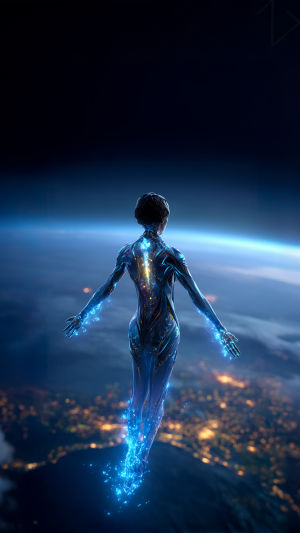
But every now and then, an image like this one stops you cold — a glowing figure suspended above a lit-up Earth, arms open wide, energy pulsing through every vein like the universe itself is running through her.
And something in your chest goes quiet. Because on some level, you recognize it. That feeling of being connected to something much, much bigger than yourself.
Turns out, that feeling isn't just poetic. It's scientifically accurate.
<h3>You Are Literally Made of Stars</h3>
This isn't a metaphor. Astrophysicist Neil deGrasse Tyson has said it plainly: the atoms in your body — the iron in your blood, the calcium in your bones, the oxygen filling your lungs right now — were forged inside dying stars billions of years ago. When massive stars reach the end of their lives, they explode in supernovas, scattering heavy elements across the galaxy. Those elements drifted through space, clumped together over millions of years, and eventually became planets, oceans, microbes, plants, and you.
The carbon atoms in your left hand might have once been part of a star in a completely different solar system. Let that sit for a second.
<h3>Why This Actually Matters Day to Day</h3>
It sounds like the kind of thing you'd read on a motivational poster and immediately forget. But understanding our cosmic origin does something subtle to the way you move through the world — if you let it. When you realize you're not just visiting this universe but are actively made from it, the boundary between "you" and "everything else" starts to feel a little less solid.
Scientists who study this — from physicists to neuroscientists — often describe a similar effect: the more people understand the scale and age of the universe, the more their everyday anxieties shrink in comparison. Not in a dismissive way. More like... perspective lands differently when you know you're a 13.8-billion-year-old event still unfolding.
<h3>The Science Behind That "Connected" Feeling</h3>
There's a name for the overwhelming sense of awe people feel when confronted with something vast — whether it's standing on a mountain, watching a storm roll in over the ocean, or staring at a photo of Earth from space. Psychologists call it the "overview effect," a term originally used to describe what astronauts feel when they first see Earth from orbit. From up there, borders disappear. Cities look like scattered embers. The atmosphere — that thin blue line protecting everything alive — looks heartbreakingly fragile.
Astronauts who experience it consistently describe coming back changed. More empathetic. Less caught up in small conflicts. More interested in protecting the planet they just saw from the outside.
You don't have to go to space to feel a version of it. Looking at images like this one — a human body lit up with the same blue energy as the atmosphere behind her — can trigger something similar in the brain. Awe, researchers have found, literally slows your heart rate and shifts your focus from self to something larger.
<h3>What To Do With All of This</h3>
Here's the honest, practical part: none of this changes your Monday morning. But it can change how you carry it. Next time you're overwhelmed, step outside at night. Find a dark spot away from city light if you can. Look up for five minutes without your phone. The stars you're seeing are hundreds to thousands of light-years away. Some of them don't even exist anymore — you're seeing their ancient light.
And the atoms in your eyes that are doing the looking? They came from out there too.
We didn't arrive in this universe. We emerged from it. That glowing figure floating above the Earth isn't a fantasy — it's just a reminder of what we already are, rendered visible.


