

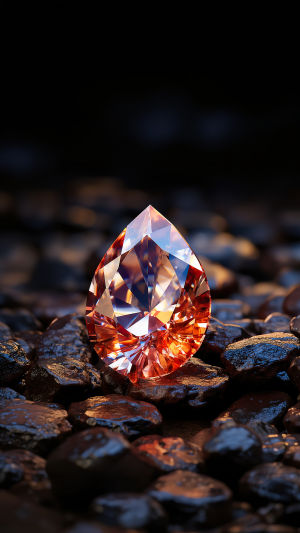
You're holding a sparkling stone in your hand, and it's dazzling—so much so that you wonder if it's truly a diamond or just a clever imitation.
Diamonds have a way of capturing attention, but their brilliance can be faked. Learning to identify the real deal isn't just for jewelers.
With a few practical techniques and careful observation, you can gain confidence in spotting authenticity before you commit to a purchase.
<h3>Check the Stone's Sparkle</h3>
Diamonds have a unique way of bending and reflecting light. They sparkle differently than glass or synthetic alternatives.
1. Observe how the stone interacts with light. A real diamond reflects sharp, bright flashes internally and creates subtle rainbow colors around the edges.
2. Compare it to a piece of glass of similar size. Glass tends to scatter light more uniformly and lacks the depth and contrast of a diamond.
3. Hold the stone at various angles to see how it disperses light.
Sharper sparkle and visible depth are key indicators here. For example, if the stone in your ring catches sunlight and produces dazzling flashes with tiny rainbow hints, it's likely a diamond. If the light is flat and uniform, it might be glass or cubic zirconia.
<h3>The Fog Test</h3>
A simple, at-home test involves using your breath to create condensation.
1. Hold the stone in front of your mouth and breathe on it lightly, creating a thin layer of fog.
2. Observe how quickly the fog disappears. Real diamonds dissipate heat almost instantly, so the fog clears immediately.
3. Repeat a couple of times to ensure accuracy and note differences with other stones.
Quick clearing and consistent results signal authenticity. Many fake diamonds will retain the fog for several seconds because they don't conduct heat as efficiently.
<h3>Examine the Setting and Mount</h3>
Diamonds are usually set in high-quality metals. Paying attention to the mount can reveal clues about the stone.
1. Look at the metal stamp on the inside of a ring or the back of a pendant. Real diamonds are often set in gold, platinum, or high-grade silver.
2. Examine the prongs or bezel. A genuine diamond is usually held securely with substantial prongs.
3. Check for imperfections. If the setting looks cheap or flimsy, the stone is more likely a replica.
Secure mount and quality metal give context. For instance, if a stone sparkles but sits in a thin, flimsy brass setting, it's probably not a diamond.
<h3>Use a Magnifier or Loupe</h3>
Looking closely can reveal internal characteristics unique to diamonds.
1. Use a jeweler's loupe or a high-quality magnifying glass.
2. Inspect for tiny inclusions—real diamonds almost always have minor imperfections.
3. Compare it to synthetic alternatives, which often appear flawless or have bubbles inside.
Visible inclusions and natural variations confirm authenticity. A flawless stone without any marks is rare and may indicate a synthetic or imitation gem.
<h3>Water Drop Test</h3>
A simple physics trick can help you see the diamond's density and surface tension.
1. Place a single drop of water on the flat top surface of the stone.
2. Observe how the water behaves. On a real diamond, the drop tends to stay together and not spread out.
3. On fake diamonds, the water usually spreads quickly across the surface.
Water cohesion and high density are distinctive. This test is subtle but effective for small stones when combined with other checks.
<h3>Seek Professional Verification When Needed</h3>
Even with these tricks, a certified gemologist can provide a definitive answer.
1. Take the stone to a reputable jeweler or gemological lab for a professional assessment.
2. Look for certification documents that detail the diamond's cut, clarity, and carat.
3. Use professional tools such as UV lights or electronic testers if uncertainty remains.
Peace of mind and accurate grading come from professional evaluation. This step is especially important for expensive purchases or heirloom pieces.
Learning these simple techniques doesn't make you a gemologist overnight, but it gives you practical skills to avoid being misled. Diamonds aren't just about sparkle—they have a pattern, density, and brilliance that set them apart. With careful observation, a bit of patience, and occasional professional guidance, you'll handle every diamond encounter with confidence and clarity.


