

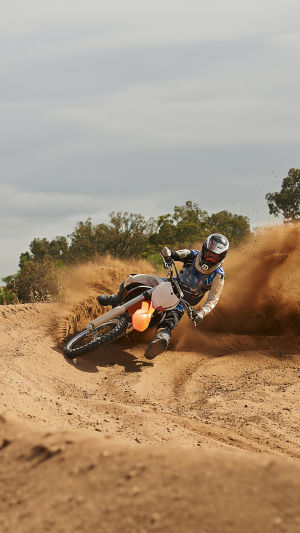
Most motorcyclists spend their time riding on asphalt, where grip is predictable and the motorcycle responds consistently.
Off-road riding introduces a completely different environment that challenges balance, traction control, and rider awareness.
More than just adventure, riding on dirt and loose terrain helps develop real-world skills that improve confidence and control in unexpected situations. The experience often changes the way riders understand both their motorcycle and the road itself.
<h3>Off-Road Riding Builds Motorcycle Control Faster Than Asphalt</h3>
Road riding rewards smoothness and precision because traction is usually reliable. Tires grip consistently, braking distances are predictable, and the motorcycle behaves in familiar ways. Even when conditions change, the surface often remains relatively stable.
<h3>Dirt changes everything.</h3>
Loose terrain constantly shifts beneath the wheels. Sand moves, mud slides, gravel scatters, and ruts pull the bike away from its intended line. Riders quickly learn that fighting the motorcycle only creates instability. Instead, they must work with the machine, allowing movement while staying balanced and controlled.
<h3>That experience develops an entirely different level of sensitivity.</h3>
When riders spend time off-road, they become familiar with sensations that would normally feel alarming on pavement. A rear tire stepping sideways, a front wheel drifting, or the bike moving underneath the rider no longer triggers panic. Instead of freezing or overreacting, experienced riders learn to stay calm, adjust body position, and maintain throttle control.
This is one reason many elite racers, including champions from professional road racing, have incorporated dirt training into their routines for years. Riding in low-grip conditions sharpens reflexes and improves feel at the limits of traction.
<h3>Real-World Road Situations Often Resemble Off-Road Conditions</h3>
Many street riders believe dirt skills are only useful on trails, but real roads frequently present the same challenges. An unexpected oil patch in a corner can instantly reduce grip. Heavy rain leaves standing water on poorly drained roads. Gravel from construction sites often collects at the edge of bends.
Fallen leaves become dangerously slick during colder months. Even painted road markings can feel unstable when wet. These situations create the same kind of uncertain traction riders face constantly off-road. Motorcyclists who have never practiced low-grip riding often react abruptly during emergencies.
They grab the front brake too aggressively, stiffen their arms, or make sudden steering inputs that upset the motorcycle. Riders with dirt experience usually respond differently because they have already learned how motorcycles behave when traction becomes unpredictable.
The benefit is not theoretical. It can directly affect accident avoidance. Even simple travel situations become easier. Reaching a remote guesthouse, beach parking area, mountain campsite, or countryside villa sometimes requires riding across dirt, sand, or uneven stone paths.
Riders unfamiliar with loose surfaces frequently struggle during these low-speed moments, where balance matters more than speed. A small amount of off-road training can prevent embarrassing and expensive tip-overs.
<h3>Technique Matters More Than Courage</h3>
One of the biggest misconceptions about off-road riding is that success depends mainly on bravery. In reality, technique matters far more. New riders often tense up because dirt riding initially feels unstable. The motorcycle moves beneath them, traction changes constantly, and the terrain appears unpredictable. However, proper instruction transforms the experience completely.
A skilled coach teaches riders how to stand correctly on the footpegs, distribute weight during climbs and descents, and use body movement to guide the motorcycle naturally across uneven terrain. Riders also learn how braking differs on dirt, particularly the importance of smooth inputs and rear brake control.
Clutch work becomes another major focus. On technical terrain, proper clutch modulation helps maintain traction while preventing stalls or sudden bursts of power that destabilize the bike.
Training exercises usually include tight slalom drills, controlled braking on loose surfaces, hill starts, obstacle crossings, and slow-speed maneuvering. These drills may appear simple, but they build muscle memory that later becomes valuable in emergency situations on public roads.
<h3>Adventure Bikes Open the Door for Everyday Riders</h3>
The rise of adventure motorcycles has made off-road riding more accessible than ever. Modern dual-purpose machines allow riders to travel comfortably on highways while still handling gravel roads, forest trails, and moderate dirt terrain with confidence. Unlike specialized enduro bikes, adventure motorcycles are designed for versatility.
They combine long-distance comfort with enough suspension travel and wheel size to tackle gravel roads, forest tracks, and rough terrain. This flexibility encourages more riders to experiment beyond pavement without committing to extreme off-road riding.
For many people, that first experience completely changes their understanding of motorcycling. Instead of focusing only on speed or cornering performance, riders begin appreciating balance, terrain reading, and technical precision. Riding becomes less about dominating the road and more about adapting to constantly changing conditions.
<h3>The Confidence Carries Back to the Street</h3>
Perhaps the greatest reward from off-road riding is confidence—not reckless confidence, but controlled confidence rooted in experience. Riders who spend time in dirt environments become more relaxed when motorcycles move underneath them.
They develop better throttle discipline, smoother braking habits, and improved awareness of traction limits. Those habits naturally transfer back to road riding.


