

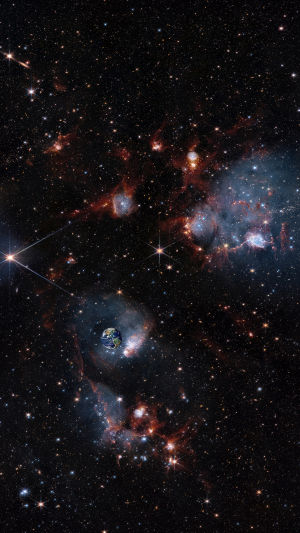
Everything we've ever seen, photographed, studied, or measured, every star, planet, galaxy, gas cloud, and particle, accounts for just about 5% of the total content of the universe.
The other 95%? We call it dark matter and dark energy, and honestly, we're still pretty much in the dark about both.
That's not a casual exaggeration. It's where physics actually stands right now. The universe is expanding, and it's doing so at an accelerating rate. Something is pushing it apart. Something else seems to be holding galaxies together better than they should based on the visible mass inside them. Scientists gave these forces names, dark energy and dark matter, but naming something and understanding it are two very different things.
<h3>Dark Matter Is the Invisible Scaffolding</h3>
Here's what tipped astronomers off about dark matter: galaxies spin wrong. In a typical spiral galaxy, stars toward the outer edges should orbit the galactic center slower than the ones near the middle, for the same reason that planets farther from the Sun take longer to complete an orbit.
However, observations show that stars near the outer edge of spiral galaxies move at roughly the same speed as those closer in. The only way to explain that is if there's a lot more mass in and around the galaxy than we can see, generating extra gravitational pull.
Dark matter makes up about 27% of the universe. It doesn't emit, absorb, or reflect light. It doesn't interact with electromagnetic radiation at all. The only thing that gives it away is gravity.
Scientists have proposed several candidates for what it might actually be, including WIMPs (weakly interacting massive particles), axions, and even primordial black holes. None of these have been directly detected yet, which makes dark matter one of the most active and frustrating searches in physics.
<h3>Dark Energy Is Even Stranger</h3>
Dark energy is a different kind of mystery. The term was coined in 1998 by University of Chicago astrophysicist Michael Turner, and he picked the name deliberately. He wanted a phrase that signaled this was a deep, unsolved problem, not something that would be easily explained away.
Two independent teams of astronomers studying supernovae in the late 1990s found that distant galaxies weren't just moving away from us, they were accelerating. The universe's expansion was speeding up, not slowing down as gravity would predict. That was shocking. As Turner put it, it was like throwing keys in the air and watching them fly up toward the ceiling instead of falling back down.
Dark energy appears to make up about 68 to 70% of all the energy and matter in the universe. Unlike dark matter, which clumps around galaxies, dark energy is uniformly spread across space. It doesn't seem to dilute as the universe expands. And it only became the dominant force in the universe's behavior relatively recently, around five billion years ago.
<h3>The Leading Theories (and Why None Fully Work)</h3>
The most popular explanation is the cosmological constant, essentially the energy of empty space itself. Einstein actually invented this concept as a mathematical fix for his equations, then discarded it. The idea was later revived.
The problem is that when physicists calculate what this vacuum energy should be based on quantum theory, the answer is off by more than 100 orders of magnitude compared to what's actually observed. That's not a small discrepancy.
Another theory, called quintessence, treats dark energy as a kind of dynamic field that changes over time. Some recent large-scale surveys of galaxies have found hints pointing in this direction, but nothing conclusive yet. A third possibility is that Einstein's general relativity is simply incomplete, and what looks like dark energy is actually a gap in our understanding of gravity itself.
"It's a bit embarrassing that we have little to no clue what 70% of the universe is," said Prof. Joshua Frieman, who co-founded the Dark Energy Survey. That about sums it up.
Science doesn't lose dignity by admitting ignorance. Dark matter and dark energy remind us that humility is part of discovery. We've mapped 5% of the cosmos with brilliance, but 95% remains a question mark. That's not failure — that's invitation. Every unknown is a door. And physics is just beginning to turn the handle.


