

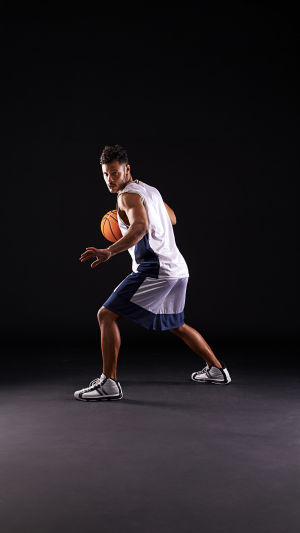
Here's the mindset shift that unlocks the crossover: it's not about switching the ball from one hand to the other.
It's about getting the defender to commit to the wrong direction before you go the other way. Visual research backs this up — defenders track your hips, your shoulders, your head.
They're reading your body, not watching the ball. So if your upper body doesn't sell the fake, your hands won't matter.
That's why Allen Iverson's crossover was so hard to stop. It wasn't just fast. It was completely unreadable.
His body language committed fully to one direction before he snapped back the other way — and by the time the defender reacted, the lane was already open.
<h3>The Full Sequence, Step by Step</h3>
Start with one or two rhythm dribbles. Read the defender's feet. When their weight plants or shifts in a direction, that's your window — not before, not after. Then sell the fake hard. Lean your shoulder, drop your head, put your weight convincingly in the fake direction. Slow and deliberate. The fake is where most beginners rush and give themselves away.
After the fake, plant your outside foot — same side as your dribbling hand — and push off hard. The bigger the push, the more separation you create. As that foot drives, snap the ball across low, just below knee height, palm angled at 45 degrees, wrist and fingertips doing the actual transfer work.
Then the most critical part: accelerate immediately. The first two steps after the crossover are everything. If you hesitate even half a second, a good defender recovers. Attack the new direction immediately.
<h3>Three Beginner Drills to Build It Right</h3>
Start with single-hand stationary dribbling. Just pound the ball below your knee level, eyes up, for thirty seconds per hand. No crossover yet. This builds the wrist control that makes clean transfers possible. Then add the stationary crossover — two hard dribbles with the right hand, snap it to the left, two more, snap back.
Keep it low, tight, quick. Low means below the defender's hands. Tight means close to your body. Quick means the transfer itself is sharp, not slow.
Once that feels consistent, move to cone work. Set up cones in a line — or stagger them — and dribble toward each one, crossover past it, attack the next. Change speeds: approach slowly, explode through the move. That rhythm of slow-to-fast is exactly what makes the crossover dangerous in a game.
<h3>Common Mistakes That Ruin the Move</h3>
The most common error is dribbling too high. A high dribble is easy to steal and telegraphs your move. Keep it below the knee. Second mistake: making it too obvious — no shoulder sell, no hesitation, just switching hands while running straight.
Defenders don't bite that. Third, and maybe the most damaging: stopping after the crossover to check if it worked. That pause lets the defender recover. The crossover ends with a burst, always. No exceptions, even in practice, because habits formed in drills show up in games.
Work in a double crossover too once the basic move is clean. First crossover doesn't create enough space? Cross right back and attack the other lane. Two quick direction changes in a row regularly catches defenders mid-step, completely off balance.


