

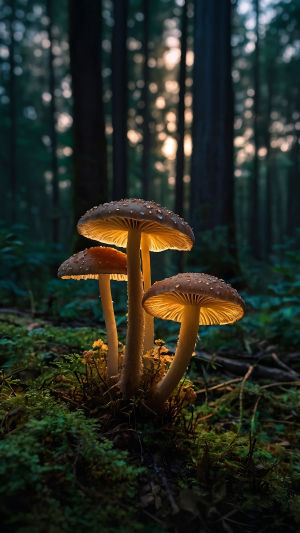
Lift a mushroom cap and place it gills-down on white paper.
Leave it for a few hours. When you come back, what you'll find isn't dust — it's a detailed print made from thousands of microscopic spores, each one a potential new organism.
A mid-sized mushroom releases up to 100 million spores per hour. Over four to six days, that's a total of around 20 billion spores from a single cap.
<h3>What Mushrooms Actually Are</h3>
Mushrooms are not plants, and they're not animals. They belong to their own kingdom entirely — Fungi — which also includes molds, yeasts, mildews, and rusts. Researchers estimate over 140,000 species of wild mushrooms exist worldwide, with around 3,000 of them edible. The mushroom itself — the cap, stem, and gills — is just the fruiting body. The real organism lives underground as a mycelium: a network of thread-like filaments called hyphae that spread through soil, rotting wood, or any suitable substrate, absorbing nutrients and moisture.
<h3>The Life Cycle: Starting With a Spore</h3>
Everything begins with a single spore landing in a cool, moist environment where food is available — damp soil, rotting wood, or decomposing leaf matter. That spore germinates and sends out hyphae, which grow by adding new cells to their tips and branching outward to form a mycelium.
On its own, that mycelium cannot yet produce mushrooms. Environmental signals trigger the next phase: fruiting. Heavy rainfall, a drop in temperature, or a change in humidity — any of these can be the trigger. The mycelium condenses into tiny structures called primordia, which mushroom growers sometimes call pins. These are the earliest visible stage of a mushroom. Given the right conditions, the primordia develop rapidly into full fruiting bodies, complete with cap, gills, and stem.
<h3>Why Mushrooms Produce So Many Spores</h3>
The numbers are staggering because they need to be. Most spores never land in a suitable environment. They travel on air currents, hitch rides on animals, or get washed away by water. The odds of any individual spore landing in exactly the right spot — moist, with available food, at a workable temperature — are extremely low. The strategy is pure volume: produce so many that a small fraction will inevitably succeed. Mushrooms are, in this way, some of the most prolific organisms on the planet. The biology is simple but the scale of it is genuinely astonishing.
Mushrooms may seem simple, but they are master strategists of the natural world. By producing astronomical numbers of spores, they ensure survival and colonization in unpredictable environments. From the hidden mycelium below to the fruiting body above, mushrooms showcase one of nature’s most impressive growth strategies.


