

The old Waldorf-Astoria Hotel came down first. Then, on the cleared Manhattan block between 33rd and 34th Streets on Fifth Avenue, something extraordinary began to happen.
Steel columns went up at a rate of four and a half floors per week. The framework alone rose at a speed that even construction workers struggled to believe they were part of.
<h3>Art Deco at Its Peak</h3>
Architect William F. Lamb of the firm Shreve, Lamb and Harmon designed the Empire State Building's 102 floors in the Art Deco style — the clean geometric lines, bold vertical emphasis, and decorative metallic detailing that defined the movement's most confident era.
The zoning laws of the time required setbacks as the building rose, creating its characteristic tapering silhouette. Lamb worked from the top down, designing the shape around its pencil-like profile from the beginning. The entire design, from first sketch to final blueprints, was completed in just two weeks.
The lobby is one of the finest interiors of the Art Deco period. Its ceiling mural depicts a celestial sky adorned with 23-karat gilded stars, gears, and sunbursts — painted over in the 1960s and later painstakingly recreated over 20,000 working hours by historians and artisans. The marble walls, the soaring ceilings, the metallic shimmer on every surface — it all communicates a particular kind of confidence in the machine age.
<h3>The Race Into the Sky</h3>
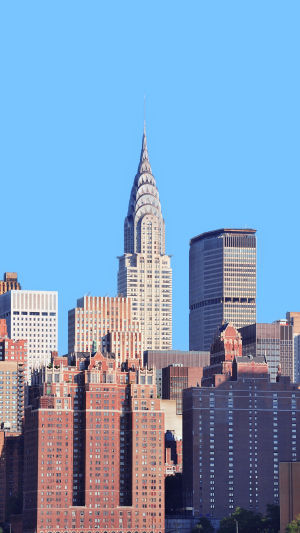
The Empire State was built during a race. The Chrysler Building had claimed the title of world's tallest in 1930, using a spire secretly assembled inside and raised at the last moment. John Raskob, who commissioned the Empire State, was determined to go higher. The design was revised more than fifteen times to ensure it would surpass any rival.
The mooring mast at the top was conceived as a docking station for airships — dirigibles would tie off there, and passengers would descend to the streets of Manhattan in seven minutes. It never worked that way; the updrafts around the roof were too severe for safe docking. The mast became an observation deck instead.
<h3>Empty, Then Beloved</h3>
The building opened in 1931, and at first the offices sat largely vacant — earning it the nickname the "Empty State Building." It only became profitable after the conflict. Since then its fortunes have reversed dramatically. The building now completes a major energy efficiency retrofit that reduced emissions by roughly 40 percent, and around four million visitors pass through each year.
The American Institute of Architects ranked it first on its list of America's Favorite Architecture. Not bad for a building that was considered a financial disaster on opening day.


