

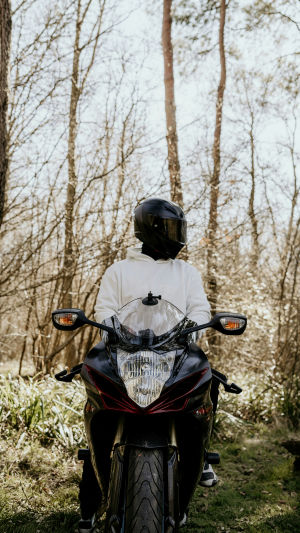
Motorcycle riding is not only about hands, throttle, brakes, and balance, Lykkers. Your head plays a surprisingly powerful role.
Where it points, your eyes follow. Where your eyes go, your steering often follows too. That tiny chain can make a ride feel smooth, clumsy, calm, or strangely wobbly.
Good head position helps you see earlier, turn cleaner, and stay more relaxed. Poor head position can make corners feel tight, traffic feel busier, and balance feel less natural. The funny part is that many riders focus on the bike first, while the real fix begins above the shoulders.
<h3>Your Head Guides the Ride</h3>
Your head is like the quiet director of the whole scene. It tells your eyes where to search, helps your balance system read movement, and gives your arms better information. When your head stays low, stiff, or pointed too close to the front wheel, the ride can feel smaller and more stressful.
<b>Eyes follow the head</b>
Riders often hear the advice to look where they want to go. That advice works because vision strongly shapes steering. If your head stays pointed down at the road right in front of you, your eyes collect late information. You notice turns, traffic changes, and road surface issues later than needed.
When you lift your head and look farther through the path, the bike feels calmer. Your brain has more time to prepare. Steering becomes smoother because you are not reacting at the last second.
Try this in a safe, quiet area. Ride slowly in a wide circle. First, look close to the front wheel. The circle may feel awkward. Then turn your head toward the path ahead. The same circle usually becomes smoother because your attention has a target.
For Lykkers, the simple cue is chin up, eyes ahead. It sounds tiny, but it can change the whole feel of a ride.
<b>Turns become easier with head rotation</b>
In a corner, many riders move their eyes but forget to move the head. The eyes glance toward the exit, but the helmet still points forward. This limits vision and can make the turn feel tighter than it is.
A better habit is to rotate the head toward the exit of the turn. Not a dramatic twist, just a clear turn of the helmet in the direction you want to travel. This helps your upper body stay organized and gives your hands a cleaner signal.
If you stare at the edge of the road, a curb, a patch, or anything you want to avoid, the bike may drift toward it. That is target fixation. The brain and hands often follow the strongest visual point. The cure is to move the head and eyes back to the safe path.
Practice with gentle turns first. Before entering, look through the turn. During the turn, keep the head aimed toward the exit. After the turn, let your eyes rise to the next section. Smooth vision supports smooth riding.
<b>Balance improves when the head stays level</b>
Your inner balance system uses head position to understand movement. If your head tilts too much, drops suddenly, or stays tense, balance can feel less clean. This is especially noticeable at slow speed, during turns, or when the road surface changes.
A stable head does not mean a frozen head. It means relaxed, level, and aware. Let the bike lean as needed, but keep your head calm enough to read the road. Think of your helmet as a camera that should give you a steady picture.
At low speed, turning the head helps balance too. When riders look down during slow maneuvers, the bike often feels heavier. When they look toward the intended path, balance usually improves. The head gives the brain a plan, and the hands stop making random tiny corrections.
<h3>Train Better Head Habits</h3>
Good head position is trainable. You do not need advanced riding tricks. You need small repeatable habits that make your vision earlier, your posture calmer, and your decisions cleaner. Start in low-pressure settings before using these ideas in busier places.
<b>Scan wide, not just forward</b>
Riding safely means reading a moving picture. Looking straight ahead is useful, but not enough. Your head should help you scan mirrors, side spaces, intersections, parked vehicles, road texture, and escape paths.
Use a rhythm. Far ahead, near path, mirrors, side spaces, then far ahead again. This keeps your awareness alive without making you nervous. The goal is not frantic head movement. The goal is calm checking.
In traffic, avoid staring at one vehicle for too long. If you lock onto the vehicle ahead, you may miss brake lights farther up, a pedestrian at the side, or a lane change developing nearby. A moving scan gives you more time.
For Lykkers, a practical game is to name the next three useful clues while riding: traffic light, road surface, vehicle spacing. This trains your head and eyes to collect information instead of waiting for surprises.
<b>Keep the neck relaxed</b>
A tense neck often leads to stiff shoulders and tight arms. Once that happens, steering can feel less natural. Head position is connected to the whole upper body.
Before starting, do a quick reset. Drop the shoulders. Loosen the jaw. Let the elbows bend. Hold the grips lightly. Then place the head upright, not pushed forward like a curious turtle.
During the ride, check for helmet pressure. If your chin is tucked down, your view shrinks. If your head is pushed forward, the neck tires faster. If the helmet keeps turning only at the last moment, your scan is probably late.
A useful cue is a soft neck, long view. It reminds you to relax and look further ahead at the same time.
<b>Practice head turns separately</b>
Head turns can feel exaggerated at first, so practice them deliberately. In a quiet area, ride gentle curves and turn your head toward the exit before the bike reaches the middle of the curve. Notice how early vision makes the path feel clearer.
For slow turns, look over the shoulder toward the direction of travel. Your hands and balance will often follow more naturally. Keep the movement smooth. Sudden head snaps can unsettle your posture.
You can also practice while stopped. Sit on the bike, hands light, and turn your head left and right without lifting the shoulders. This teaches the neck to move independently instead of dragging the whole upper body along.
Over time, better head habits become automatic. The bike may feel more stable, not because it changed, but because your guidance became cleaner.
Head position is one of the most overlooked riding skills. It shapes vision, balance, steering, and confidence. For Lykkers, the useful steps are simple: keep the chin up, look farther ahead, rotate the head through turns, scan calmly, and relax the neck. When the head leads well, the rest of the ride often follows with less effort.


