

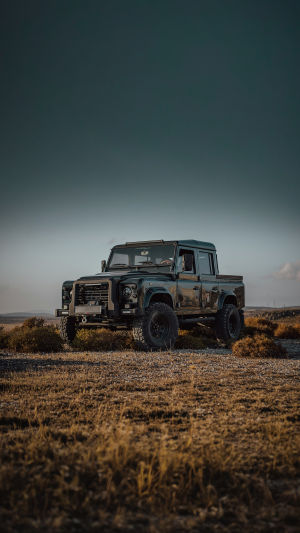
Both badges carry serious off-road history. The Land Rover Defender spent decades crossing desert and savannah, while the Toyota Land Cruiser built a reputation for virtually unbreakable reliability across remote terrain.
In 2026, though, the gap between them has widened in ways that matter to actual buyers.
<h3>Engine and Power Options</h3>
The Land Cruiser runs a single turbocharged 2.4-liter hybrid four-cylinder making 326 horsepower and 465 lb-ft of torque. It's adequate and reasonably efficient, but there's no alternative — every Land Cruiser gets the same powertrain.
The Defender goes wider. The base four-cylinder turbo produces 296 horsepower, the six-cylinder mild hybrid steps up to 395 horsepower, and the Defender OCTA pushes the performance ceiling far beyond either. More options means more ways to match the vehicle to what a specific buyer actually needs.
<h3>Off-Road Hardware</h3>
Both vehicles come with locking differentials and terrain-specific drive modes, so the core hardware is competitive. The Land Cruiser has Multi-Terrain Select with Crawl Control across mud, dirt, and sand settings, plus a stabilizer disconnect for better axle articulation. That's a solid setup.
The Defender adds Electronic Air Suspension that automatically adjusts ride height depending on the obstacle or road surface. Available Adaptive Off-Road Cruise Control maintains a set speed across technical terrain, which lets the driver focus on line selection rather than managing the throttle.
Ground clearance also favors the Defender — the 110 sits at 8.9 inches compared to the Land Cruiser's 7.9 inches, a full inch of difference that matters on rocky trails and deep ruts.
<h3>Interior and Technology</h3>
Inside, the Defender runs a 12.3-inch Pivi Pro touchscreen with sharp graphics and intuitive controls, plus a Meridian surround sound system that holds up well on long drives. The Land Cruiser's interior is more restrained — the screen is smaller and the overall cabin feels less feature-rich by comparison. For someone spending long stretches in the vehicle, the technology gap feels noticeable.
<h3>Reliability and Ownership</h3>
This is where the Land Cruiser has historically held an edge, and that reputation is still real. Toyota's reliability record across decades of hard use in remote regions is well documented. The 2026 Defender scores 82 on J.D. Power's reliability rating compared to 73 for the Land Cruiser — numbers that suggest Defender has improved significantly, though long-term durability across many years remains something the Land Cruiser has proven more thoroughly.
<h3>Which One to Choose</h3>
For buyers who want more engine choices, more adjustable off-road technology, and a more refined interior, the 2026 Defender has a clear argument. For buyers who put long-term mechanical reliability above everything else and want a simpler, more proven platform, the Land Cruiser still makes a strong case. Neither is a wrong choice — they just prioritize different things.
Choosing between the 2026 Defender and Land Cruiser comes down to one question: what matters more to you — technology and driving experience, or decades of proven reliability? The Defender offers a modern, adaptable, and more luxurious package with genuine off-road capability.
The Land Cruiser delivers the peace of mind that comes from a simpler, tougher platform built to survive neglect. Test drive both. Take them on the same trail if you can. Then decide which voice in your head is louder — the one that wants adventure today, or the one planning for a decade from now.


