

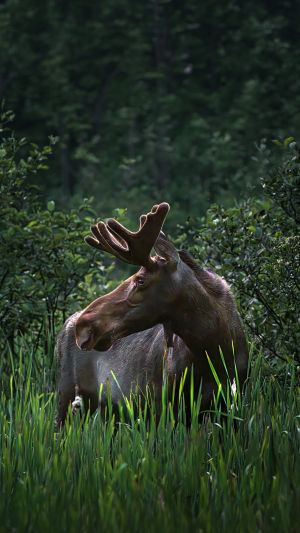
Have you ever watched a large forest animal moving into a lake and wondered how it does not just sink or struggle? Today, Lykkers, we focus on the moose. It is one of the most impressive animals living in northern forest regions, and its movement in water often surprises people.
At first sight, the moose looks heavy and slow on land. But once it enters water, its behavior changes in a fascinating way. Instead of sinking, it moves smoothly, almost like it is gliding. This unusual ability comes from a mix of body design, strength, and natural adaptation.
<h3>The moose body and why it supports water movement</h3>
The moose has a body structure that works better in water than it appears at first glance. Even though it is large, its bones are not overly compact, and its body contains enough natural buoyancy to help it stay afloat.
Its long legs are especially important. In water, they act like long paddles, pushing against resistance to create forward motion. Instead of quick movements, the moose uses slow and steady steps that help it maintain balance.
This combination of weight distribution and limb length allows the moose to move without sudden sinking or instability.
<h3>Strong swimming skills across long distances</h3>
The moose is not just able to float; it is also a strong swimmer. It can cross large lakes and wide river sections with steady energy use. Its movement is calm and controlled, showing endurance rather than speed.
When swimming, the moose keeps its head above the surface while its body stays mostly submerged. This posture helps reduce drag and allows it to travel efficiently. It can also adjust direction easily, even in deeper water.
In some cases, moose are known to cover long distances between forest areas using water routes, especially when searching for better feeding grounds.
<h3>Feeding behavior underwater</h3>
One of the most interesting behaviors of the moose is its underwater feeding habit. It is able to dive below the surface to reach aquatic plants growing on lake beds or river bottoms. To do this, the moose lowers its head and uses its strong neck to pull up vegetation. It can remain underwater long enough to gather food before resurfacing. This ability gives it access to food sources that many other forest animals cannot reach.
Because of this, water is not just a barrier for the moose—it is also a feeding environment.
<h3>Senses that guide survival in water and forest</h3>
The moose relies heavily on its sense of smell. Even when vision is limited by water or dense forest, it can detect plants, open paths, or nearby movement.
Its hearing also helps it stay aware of its surroundings. Subtle sounds in the environment allow it to sense possible changes nearby. These senses work together to support safe movement both on land and in water.
Although its eyesight is not the strongest, its other senses compensate well, helping it survive in complex environments.
<h3>Life in cold forest regions</h3>
Moose are mainly found in northern forest zones where seasons change dramatically. In snowy conditions, they move through deep snow with surprising ease due to their long legs.
During warmer periods, they often stay close to lakes, rivers, and wetlands. These areas provide both food and cooler environments. The moose adapts its movement and feeding habits depending on seasonal conditions.
This flexibility is one of the reasons it remains one of the most successful large mammals in its habitat.
So Lykkers, the moose is not just a forest giant walking through trees—it is also a skilled swimmer and underwater feeder. Its ability to move smoothly in water comes from a perfect mix of body design, strong limbs, and natural senses.
Next time you think about large animals and water, remember the moose and its surprising “floating” ability. What other forest animals do you think have hidden skills like this?
Share your thoughts, and let’s keep exploring the wonders of wildlife together.


