

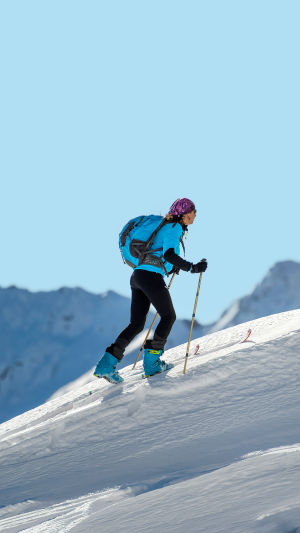
When we talk about ski mountaineering, we are describing a sport that combines climbing up steep snowy terrain and skiing back down with control.
It is not only about sliding downhill, but also about efficient ascent, step by step, across changing mountain conditions.
To handle both directions of movement, we rely on a carefully designed set of equipment. Each item in this system helps us move safely, smoothly, and efficiently through demanding alpine environments.
<h3>Boots Designed for Ascent and Descent</h3>
Ski mountaineering boots are built for two key modes: walking and skiing. In walking mode, the heel is free, allowing natural ankle movement. This makes uphill travel more efficient and reduces fatigue during long climbs.
When we switch to skiing mode, the boot locks firmly, giving strong support for downhill control. This firm structure helps transfer power directly from our legs to the skis, improving stability and precision.
The sole is often designed with curved traction patterns to improve grip on steep or icy surfaces. Modern materials, including lightweight composites, have significantly reduced boot weight while improving durability and performance.
When choosing boots, stiffness is an important factor.
A stiffer design improves control during skiing, while a slightly softer option may feel more comfortable for long climbs. Fit remains essential, as a secure but comfortable fit helps us maintain control across varied terrain.
<h3>Skis Built for Efficiency and Stability</h3>
In ski mountaineering, skis are designed to balance uphill efficiency and downhill performance. Compared with traditional downhill skis, they are generally lighter and narrower, making ascents less demanding.
The internal structure of skis plays a major role in performance. Wood cores provide natural stability, while foam, fiberglass, and advanced composites help reduce weight. Some high-end models also include reinforced materials for added strength and durability.
Modern ski designs often feature slightly wider tips to improve flotation and stability during descent, while keeping overall weight low for climbing efficiency. Competitive models follow strict international standards for length, width, and weight.
<h3>Bindings Connecting Movement and Safety</h3>
Bindings are a critical link between boots and skis in ski mountaineering. They allow us to switch between walking mode and skiing mode depending on terrain conditions.
During uphill movement, the heel is free, and different climbing positions can be adjusted to reduce strain on steep slopes. Some bindings include adjustable heel risers, helping us maintain a more natural stepping rhythm.
In skiing mode, bindings lock securely to ensure precise control. In the event of a fall or strong impact, they are designed to release automatically, helping reduce injury risk by separating boots from skis.
Many modern bindings are also built to be lightweight while maintaining strength, and some models support additional traction tools for icy or firm snow conditions.
<h3>Climbing Skins for Reliable Uphill Grip</h3>
Climbing skins are attached to the underside of skis to provide grip when moving uphill. They allow forward sliding while preventing backward slipping, making ascent much more efficient.
Most modern skins are made from mohair, synthetic fibers, or blended materials. One direction offers strong grip on snow, while the opposite direction allows smooth glide.
Different materials offer different advantages. Synthetic skins are durable and work well in harsh conditions, while mohair-based skins provide smoother glide and better resistance to moisture and freezing, making them popular for performance-focused use.
Proper maintenance is important, especially in cold environments where ice or moisture can affect adhesion and grip performance.
<h3>Poles Supporting Balance and Rhythm</h3>
Ski mountaineering poles help us maintain balance, set climbing rhythm, and assist in both ascent and descent. Adjustable-length poles are especially useful, as they can be shortened for climbing and lengthened for descending.
Lightweight materials like carbon composites reduce fatigue during long climbs. A good pole setup includes comfortable grips, secure straps, and wider baskets that prevent sinking into soft snow.
These details help us maintain steady movement across varied terrain, from steep ascents to open descents.
<h3>Backpacks Designed for Mountain Mobility</h3>
A ski mountaineering backpack is designed to carry essential gear while allowing full freedom of movement. One of its key features is the ability to carry skis without removing the pack.
These backpacks include multiple systems: a stable carrying frame, organized storage compartments, and external attachment points for equipment. This allows us to carry clothing layers, hydration systems, and safety tools in an efficient way.
Some models also include dedicated compartments for rescue tools and hydration systems. Weight, fit, and durability are key considerations when selecting a pack. A well-fitted backpack remains stable even during fast movement or technical climbs.
<h3>Helmets for Protection and Comfort</h3>
Helmets in ski mountaineering are designed to protect against impact while maintaining comfort in cold and variable environments. They typically include a hard outer shell, energy-absorbing inner foam, adjustable sizing systems, and ventilation channels.
Ventilation helps regulate temperature, though placement must be balanced to avoid fogging eyewear. Many helmets also include attachment points for goggles and lighting systems.
A properly fitted helmet can last several seasons unless it experiences a significant impact, in which case replacement is necessary for continued protection.
<h3>Safety Equipment for Changing Mountain Conditions</h3>
Safety tools are essential in ski mountaineering due to unpredictable mountain environments. A basic safety set includes a shovel, a probe, and a signal device used for locating individuals in emergency situations.
These tools are designed for fast response during rescue operations, improving efficiency when time is critical.
Another important safety device is an inflatable air system integrated into a backpack. When activated, it expands rapidly, helping increase visibility and reducing the chance of burial in moving snow conditions.
Studies suggest that such systems can improve survival chances by lowering burial risk in critical situations.
<h3>Final Thoughts — Building Confidence in Ski Mountaineering</h3>
When we combine all these components—boots, skis, bindings, skins, poles, backpacks, helmets, and safety tools—we create a complete system that supports every stage of ski mountaineering.
Each piece plays a specific role in helping us move efficiently, climb steadily, and descend with control. For Lykkers exploring this sport, understanding the full equipment system is the foundation for safer and more confident mountain experiences.
So next time we look at a steep snowy route or a distant ridge, we can ask ourselves: are we ready with the right setup to explore it in ski mountaineering?


