

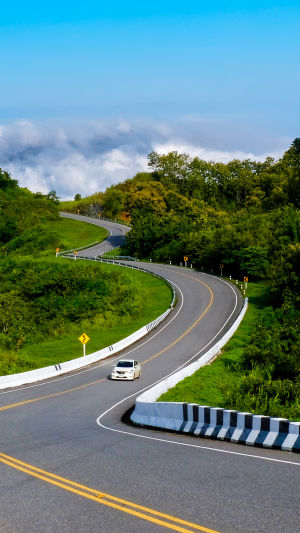
When we enjoy road trips, the open road often feels exciting and free. However, once the route shifts into winding mountain paths, the experience changes quickly. Many drivers may notice that driving becomes more demanding, focused, and requires greater attention.
Mountain roads feature sharp curves, changing slopes, and narrower lanes compared to city streets. Even experienced drivers may feel increased pressure when visibility decreases or when the road bends unexpectedly.
That is why learning a few practical driving habits can help us stay more confident, stable, and in control behind the wheel. Let us explore some essential habits that can make mountain driving safer and more comfortable.
<h3>Maintaining Full Attention on the Road</h3>
When driving long distances, especially during travel, it is easy to feel tired without realizing it. Mountain routes require even greater awareness because conditions can change quickly.
We should remain fully focused on the road at all times. Distractions or delayed reactions can make it harder to handle sudden curves or unexpected changes. A steady and alert mindset helps us respond more smoothly and safely.
If driving responsibilities are shared, taking turns helps reduce fatigue. When driving alone, short breaks after a few hours help restore attention and maintain stable reaction time. A calm and alert driver significantly improves overall travel safety.
<h3>Using Proper Steering Control</h3>
On winding roads, steering control becomes especially important. Drivers often need to turn the wheel more frequently and with greater precision than on flat roads.
Using both hands on the steering wheel provides better control, stability, and faster response. A balanced grip allows smoother adjustments when curves appear suddenly. Driving with one hand can reduce stability during quick or sharp turns.
A recommended position is keeping both hands in a steady and balanced grip on the wheel. This helps maintain control, especially when roads become narrow or unpredictable. Proper steering technique builds confidence and improves safety on every curve.
<h3>Maintaining a Stable and Appropriate Speed</h3>
Mountain roads often include both uphill and downhill sections. These variations require careful adjustment of speed and driving mode.
Using a lower driving range or gear helps maintain better vehicle control. In vehicles with manual control systems, lower gears support smoother movement on steep slopes. In automatic systems, low-speed or downhill control modes help maintain steady performance.
This approach improves control in both directions. On uphill sections, it provides stronger power support. On downhill sections, it helps reduce excessive braking and supports smoother control. This creates a more balanced and stable driving experience overall.
<h3>Keeping Safe Distance and Smooth Speed Control</h3>
Visibility on mountain roads can be limited by curves, trees, or elevation changes. Because of this, maintaining a safe distance from the vehicle ahead is essential.
A wider following distance allows more time to react to sudden changes in traffic or road conditions. If the vehicle ahead slows down unexpectedly, a safe gap ensures smoother and safer responses.
At the same time, maintaining a steady and controlled speed helps reduce sudden movements. Smooth driving improves stability and makes it easier to navigate curves safely. When distance and speed are properly balanced, the journey becomes safer, calmer, and more predictable.
<h3>Practicing Patience and Avoiding Risky Overtaking</h3>
Mountain roads often have limited space and sharp bends, which reduce forward visibility. Because of this, overtaking in curved sections can be dangerous.
It is safer to remain patient and wait for straight and clearly visible sections before considering passing. Curves may hide oncoming vehicles or obstacles, making judgment difficult.
A patient and steady driving approach supports safety for everyone on the road. Avoiding unnecessary risks helps ensure a smooth and controlled journey.
<h3>A Smoother Journey Starts With Small Habits</h3>
Lykkers, mountain driving does not need to feel overwhelming. By building simple but effective habits—staying focused, using proper steering control, maintaining safe speed, keeping distance, and practicing patience—we can create a safer, smoother, and more confident driving experience.
Every journey becomes more enjoyable when we approach the road with care, awareness, and responsibility. These small habits together make a meaningful difference in overall driving safety.


