

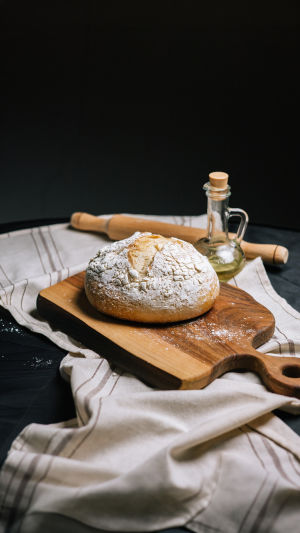
Hello Lykkers, today we are making a simple homemade no-knead European-style bread. This bread is known for its soft inside, light crust, and natural wheat aroma. The special part is that we do not knead the dough at all. Instead, we let time do most of the work.
The process is easy to follow and beginner-friendly. We only need a few basic ingredients and a bit of patience. By using long fermentation, the bread develops a soft structure with small air pockets, giving it a pleasant texture that pairs well with sweet or savory spreads.
<h3>Ingredients We Need</h3>
To make one medium-sized loaf, we prepare the following:
- Bread flour: 300 g
- Water: 230 g (room temperature)
- Salt: 2 g
- Sugar: 10 g
- Olive oil: 15 g
- Dry yeast: 3–5 g (use 3 g in warm weather, 5 g in cooler conditions)
These ingredients are simple and easy to find. There is no need for milk or butter. The softness of the bread comes mainly from hydration level and fermentation time.
<h3>Step 1: Preparing the Mixing Bowl</h3>
We start by placing the bread flour into a large mixing bowl. Then we create small sections inside the bowl:
- Place salt on one side
- Place sugar on another side
- Make a small well in the center for yeast
- Add the dry yeast into the center so it is slightly protected before mixing.
This helps keep the fermentation balanced at the beginning.
<h3>Step 2: Adding Liquid Ingredients</h3>
- Next, we slowly pour water along the edge of the bowl. This helps distribute moisture evenly. Then we add olive oil around the sides.
- We do not rush this step. The goal is to gently combine everything without overworking the mixture. At this point, the mixture will look rough and slightly sticky, which is completely normal.
<h3>Step 3: Gentle Mixing</h3>
- We use a spatula to fold everything together. The motion is simple: lift, fold, and turn.
- This step takes only about 2–3 minutes. There is no need for kneading or strong pressure. The mixture will gradually become a soft, sticky mass with a rough surface. It may not look smooth, but that is part of the process.
- Once combined, we cover the bowl with a lid or plastic wrap.
<h3>Step 4: First Fermentation</h3>
- We let the mixture rest for a long fermentation period.
Two options are available:
- Room temperature (15–28°C): about 5–7 hours
- Refrigerator overnight: 8–12 hours
- During this time, small air bubbles will appear. The volume will increase, and the texture will become lighter.
- We know it is ready when the surface looks soft and slightly domed, and the inside shows visible air pockets.
<h3>Step 5: Shaping the Dough</h3>
- We lightly dust a clean surface with flour and transfer the fermented mixture onto it.
Then we begin shaping:
- Gently fold the edges toward the center
- Press lightly to remove large air pockets
- Rotate and repeat folding
- Gather into a round shape
- We do not use force. The goal is to create structure while keeping some air inside.
- The surface slowly becomes smoother as we continue shaping.
<h3>Step 6: Second Rise</h3>
- We place baking paper on a tray and transfer the shaped loaf onto it. Lightly dust the top with flour.
- Then we place it inside the oven (turned off) or a warm space for the second rise.
- This step takes about 40–60 minutes. The dough should become roughly double in size.
- We avoid over-proofing. If it rises too much, the structure may weaken and the flavor can become slightly sour.
<h3>Step 7: Scoring and Baking</h3>
- We preheat the oven to 220°C for about 10 minutes.
- Before baking, we gently cut a shallow line on the surface. This helps control how the bread expands in the oven.
- Then we place the tray inside and add a small amount of hot water at the bottom of the oven to create steam. This helps form a light crust.
- We bake at 200°C for about 25–30 minutes.
- Every oven is slightly different, so we watch the color. When the surface turns golden brown and a warm aroma fills the kitchen, it is close to ready.
<h3>Cooling and Enjoying</h3>
After baking, we remove the bread and let it cool completely on a rack.
This step is important because cutting too early can affect texture. Once cooled, the inside becomes soft with visible air pockets.
We can enjoy it plain or pair it with spreads, fruit-based toppings, or simple light pairings. It stays fresh for about two to three days at room temperature when covered with a clean cloth.
Lykkers, this no-knead bread shows how simple ingredients and time can create something warm and satisfying. There is no complicated equipment, just a bowl, patience, and attention to texture. Each bake may feel slightly different, and that is part of the learning process. With practice, we start to understand how the mixture changes from step to step.
If you try this method at home, take your time and enjoy the process. Homemade bread is not only about the result, but also about the quiet moments along the way.


