

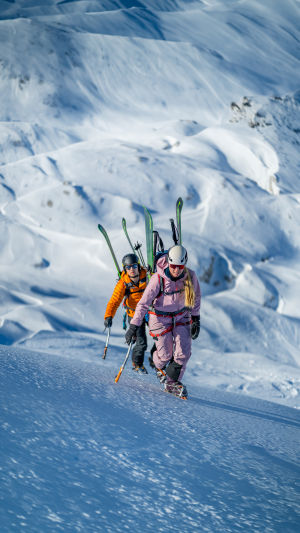
Friends and outdoor enthusiasts, have we ever imagined what it feels like to move across snowy mountains with a steady rhythm—ascending step by step and then gliding down smooth slopes in one uninterrupted flow?
This is the essence of ski mountaineering, a winter activity that blends movement, nature, and freedom. In recent years, this activity has gained global attention. While it may seem unfamiliar at first, it becomes approachable once we understand its basic styles and equipment. Let’s explore it in a clear and practical way.
<h3>Three Main Ways We Experience Ski Mountaineering</h3>
<b>Ski Racing</b>
Ski racing focuses on speed. Participants move uphill quickly with skis attached or carried, then descend as fast as possible. It is energetic, competitive, and often seen in training or organized events.
<b>Skimo (Ski Mountaineering)</b>
Skimo is more technical. It involves climbing snowy terrain using skis and may include additional safety tools in complex mountain conditions. It requires endurance, skill, and strong mountain awareness.
<b>Classic Ski Touring</b>
Classic ski touring is the most beginner-friendly style. It involves climbing uphill using skis and descending naturally without strict timing. It feels like a combination of hiking and skiing, offering a calm and enjoyable outdoor experience.
Among these, ski touring is often the most suitable starting point for beginners.
<h3>Can Beginners Try This Activity?</h3>
A common question is whether ski mountaineering is only for experienced athletes. The answer is no. Many people with basic snow experience or hiking interest can begin learning it safely.
The key is to start with simple terrain and proper guidance. There is no need to attempt difficult slopes at the beginning. Gentle snowy paths allow us to learn movement, balance, and rhythm in a safe and natural way.
What makes this activity special is the balance between effort and reward. We climb gradually step by step, then enjoy smooth downhill movement. This rhythm creates a strong connection with the mountain environment.
<h3>Essential Equipment Overview</h3>
Before stepping onto the snow, it is important to understand the basic equipment. Each component plays a key role in safety, comfort, and performance.
<b>Ski Boards</b>
Ski boards are the foundation of the activity. Lightweight skis are easier for uphill movement, while slightly wider skis provide better stability during downhill sections.
A balanced option is typically a mid-width ski, which supports both climbing efficiency and stable descent. Ski length is usually chosen slightly shorter than body height for better control and comfort.
<b>Binding Systems</b>
Bindings connect boots to skis and come in two main types:
- Frame bindings: The boot is fixed onto a frame that lifts together during uphill movement. This system is simple but heavier.
- Pin bindings: The boot connects through dedicated inserts, allowing the heel to lift freely during climbing. This reduces weight and effort, making it more efficient for long ascents.
Pin systems are widely preferred today due to their lightweight design and comfort during extended climbs.
<b>Grip Skins</b>
Grip skins are attached to the underside of skis to prevent slipping during ascents. They allow forward movement while preventing backward sliding.
They are typically made from durable synthetic fibers designed to provide traction on snow. Proper fitting is essential to ensure smooth and stable movement.
<b>Ski Boots</b>
Special boots are designed for both walking and skiing modes.
- In walking mode, the ankle moves freely to support uphill climbing.
- In skiing mode, the boot becomes stiff for better control during descent.
Comfort and compatibility with bindings are the most important factors when selecting boots.
<b>Ski Poles</b>
Ski poles provide balance and rhythm during both climbing and descending.
They are usually adjustable to suit different terrains. A wider basket improves stability in soft snow, while a durable tip enhances grip on harder surfaces. Lightweight design and ergonomic handles help reduce fatigue during longer journeys.
<h3>Starting Your First Snow Experience</h3>
Beginners are encouraged to start on guided routes or gentle terrain with stable conditions. The focus should be on learning rhythm and movement rather than speed or distance.
With practice, confidence improves naturally. Over time, longer routes and more varied landscapes can be explored, offering a deeper connection with winter environments.
<h3>Closing Thoughts</h3>
Ski mountaineering is more than a sport. It is a meaningful way to experience nature through steady climbing and smooth descent. It offers a refreshing escape from daily routines and a unique way to engage with winter landscapes.
So friends, are we ready to take the first step into this snowy journey? With preparation, patience, and curiosity, every mountain becomes a path of discovery—one step and one glide at a time.


