

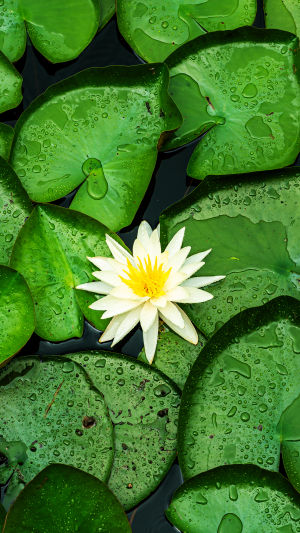
It’s great to see you, Lykkers! Have you ever wondered why lotus leaves always look clean, even when they grow in muddy water?
This remarkable feature is known as the Lotus Effect, a natural self-cleaning mechanism that helps the plant stay free of dirt and contaminants.
Scientists have studied lotus leaves for decades to understand how their unique surface repels water and carries away dust particles. The discoveries inspired innovative applications in fields such as architecture, manufacturing, and environmentally friendly materials.
The phenomenon is so impressive that researchers coined a special term for it: the “Lotus Effect.” What appears to be a simple leaf shedding water is actually a sophisticated natural design that combines chemistry and microscopic structures. Today, this discovery influences products ranging from self-cleaning paints to environmentally friendly decorative materials.
<h3>The Secret Hidden on the Leaf Surface</h3>
At first glance, a lotus leaf looks smooth. Under a microscope, however, an entirely different landscape appears. The surface is covered with tiny protrusions formed by the leaf’s outer cells. On top of these microscopic bumps lies another layer of complexity: minute wax crystals.
This dual structure is what makes the leaf extraordinary. The wax itself repels water, but the microscopic roughness amplifies this effect. Instead of spreading across the surface, water gathers into nearly spherical droplets. Scientists describe such surfaces as “superhydrophobic,” meaning they repel water to an extreme degree.
Unlike ordinary water-resistant materials, superhydrophobic surfaces allow droplets to sit on top of microscopic air pockets rather than fully contacting the surface.As a result, water barely touches the leaf and can move freely with even the slightest tilt or breeze.
<h3>Why Water Becomes Nature’s Cleaning Tool</h3>
The self-cleaning process begins when raindrops or dew land on the lotus leaf. Because the droplets remain almost perfectly round, they can easily roll across the surface. As they move, these droplets collect dust particles, pollen grains, fungal spores, and other contaminants.
The dirt adheres more strongly to the water than to the leaf itself. Eventually, the droplet rolls away, carrying the debris with it.
This process is remarkably efficient. Even leaves growing in muddy environments remain surprisingly clean because dirt particles are continuously removed whenever moisture is present. For the plant, cleanliness is not merely cosmetic. A cleaner surface allows sunlight to reach photosynthetic tissues more effectively. It also reduces the accumulation of microorganisms that could potentially damage the leaf.
<h3>The Lotus Effect Is Not Unique to Lotus Plants</h3>
Although the term “Lotus Effect” became famous, researchers emphasize that lotus plants are not the only species with this ability. According to plant materials expert Nico Bruns of the Technical University of Darmstadt in Germany, similar principles can be found in various plant species. Some leaves possess comparable combinations of wax coatings and microscopic surface textures that create highly water-repellent behavior.
The lotus became the symbol of this phenomenon largely because its performance is particularly striking and because the flower has long been associated with purity in many Asian cultures. The name helped the concept gain public attention and inspired numerous commercial applications.
<h3>From Botanical Discovery to Everyday Technology</h3>
Once scientists understood how lotus leaves worked, engineers began looking for ways to replicate the effect. One of the earliest applications was self-cleaning exterior paint. These coatings are designed with microscopic textures that encourage rainwater to remove dirt from building surfaces. Instead of accumulating grime over time, walls can remain cleaner with less maintenance.
The same concept has been explored for glass surfaces, solar panels, and vehicle windshields. In theory, rainwater can help clear dust and debris, improving visibility and reducing cleaning requirements.
However, there is an important difference between plants and manufactured materials. A lotus leaf can continuously regenerate its surface as it grows. Synthetic coatings eventually experience wear from weather, abrasion, and environmental exposure. Maintaining long-term performance remains one of the major challenges for researchers.
<h3>What Plant Cuticles Can Teach Science</h3>
The Lotus Effect represents only one aspect of a much larger story. Scientists involved in the European research project PlaMatSu investigated plant cuticles—the protective outer layer covering leaves. A cuticle is not a simple coating. It is produced by living cells beneath the surface, which release a complex mixture of waxes, proteins, and carbohydrates. Together, these substances create a protective barrier with highly specialized properties.
Researchers discovered enormous diversity among plant cuticles. Some are smooth, while others are wrinkled, ridged, or covered with spikes. These structures influence how insects interact with leaves, how water moves across surfaces, and how plants respond to environmental conditions.
Understanding these natural designs could help scientists create advanced materials that resist contamination, discourage pests, or protect sensitive surfaces without relying heavily on chemical treatments.
<h3>Structural Colors and a Sustainable Future</h3>
Another intriguing feature found in certain plant cuticles is structural color. Unlike pigments, which absorb and reflect specific wavelengths of light, structural colors arise from microscopic arrangements that manipulate light directly. This phenomenon is famously observed in some butterfly wings, where brilliant colors emerge from nanoscale structures rather than chemical dyes. Similar effects also occur in certain plants.
Inspired by these natural systems, researchers developed cellulose-based films capable of producing color through structure alone. Because cellulose comes from plant material, these films offer a promising sustainable alternative to conventional plastics.
One potential application is biodegradable glitter. Traditional glitter often contains plastic particles that persist in the environment for years. Cellulose-based alternatives could provide the same visual appeal while breaking down naturally after disposal.
The lotus leaf demonstrates how elegant solutions can emerge from millions of years of evolution. Through a combination of microscopic architecture and water-repellent chemistry, it transforms ordinary raindrops into an effective cleaning system.


