

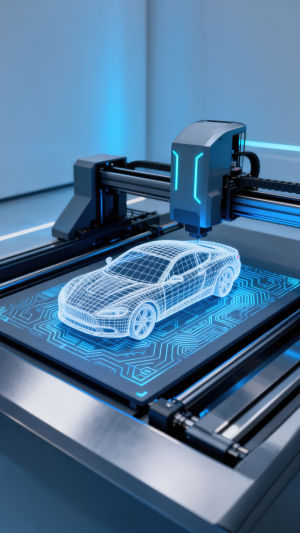
Hi, Friends! If you have ever looked under the hood of a modern car and wondered how all those intricate parts come together so precisely, the answer increasingly involves 3D printing.
What was once a niche technology used mainly for quick prototypes has evolved into a genuine force reshaping the entire automotive manufacturing process.
<h3>From Prototypes to Real Parts</h3>
Automakers have relied on 3D printing for rapid prototyping for years, and that use case remains powerful. Designers can create a physical model of a new component within hours instead of waiting weeks for a traditionally machined part. This speed compresses the development cycle significantly, letting engineers test fitment, ergonomics, and aesthetics before committing to expensive tooling.
However, prototyping is now just the starting point. Manufacturers are increasingly using 3D-printed components directly in production vehicles. Interior fixtures, air ducts, brackets, and even some structural components are coming off printers and going straight into cars. The shift from "print to test" to "print to install" marks a fundamental change in how the industry thinks about fabrication.
<h3>Tooling and Jigs on the Factory Floor</h3>
One of the most practical and immediately impactful applications is in manufacturing aids. Jigs, fixtures, and assembly tools that workers use on the production line can be 3D printed quickly and cheaply. Traditional methods of producing these items required weeks of lead time and significant budget. With in-house printers, a factory team can design a custom holding jig in the morning and have it printed and in use by the afternoon.
This agility reduces downtime and allows plants to respond to design changes without massive disruption. Companies like Ford and BMW have integrated 3D printing into their production floors specifically for this reason, generating measurable cost savings and efficiency gains across their facilities.
<h3>Lightweighting and Complex Geometry</h3>
One of the most compelling advantages of 3D printing is the ability to produce geometries that traditional manufacturing simply cannot achieve. Through a design approach called topology optimization, engineers can create parts that remove unnecessary material while maintaining or even improving structural integrity. The result is components that are lighter without being weaker.
Weight reduction matters enormously in automotive engineering. Lighter vehicles consume less fuel, produce fewer emissions, and generally handle better. 3D printing makes it feasible to produce lattice structures, internal channels, and complex contours that would be impossible or prohibitively expensive to machine conventionally.
<h3>Customization at Scale</h3>
Personalization is a growing expectation among vehicle buyers, and 3D printing is one of the clearest technological pathways to delivering it. Custom interior trim pieces, bespoke seat components, and personalized badging can be produced in small quantities without the cost penalties associated with traditional low-volume manufacturing.
Luxury and performance brands have been particularly active in exploring this space. A customer who wants a specific texture on a dashboard panel or a unique console insert can have those items produced on demand. This kind of flexibility was economically unfeasible before additive manufacturing matured to its current state.
<h3>Spare Parts and Supply Chain Resilience</h3>
The automotive supply chain is complex and vulnerable to disruption, as recent years have demonstrated clearly. 3D printing offers a meaningful solution by enabling on-demand production of spare parts. Instead of warehousing thousands of components for vehicles that may be decades old, manufacturers and dealers can store digital files and print parts only when needed.
This approach is especially valuable for classic and discontinued models where original parts are scarce. It also reduces the logistical burden of maintaining physical inventory across global networks, making supply chains leaner and more responsive.
<h3>Materials Continue to Advance</h3>
Early 3D-printed automotive parts were limited by the properties of available materials, mostly basic plastics that were fine for visual prototypes but unsuitable for functional use. That limitation has eroded substantially. High-performance polymers, fiber-reinforced composites, and metal printing technologies now allow the production of parts that meet the thermal, mechanical, and durability requirements of real-world automotive use.
Metal additive manufacturing, in particular, has opened doors in areas like exhaust components, suspension brackets, and other high-stress applications where precision and strength are non-negotiable.
The convergence of better materials, faster machines, and more sophisticated software is pushing 3D printing from a supporting role into a central position in automotive manufacturing strategy. For anyone following the future of transportation, this technology is absolutely worth watching closely. The cars being designed and built right now reflect just a fraction of what additive manufacturing will eventually make possible.


