

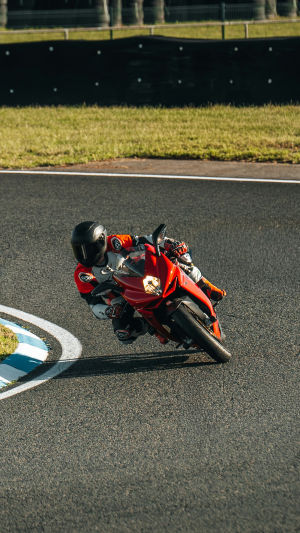
When we ride a motorcycle into a curve, the feeling of the machine leaning closer to the ground can be both exciting and tense. If the footpeg touches the road, it usually means the motorcycle is approaching its designed lean limit.
This guide helps us understand how to avoid that situation. We will explore three key areas: how the motorcycle itself behaves, how our body influences balance, and how smart route choices can reduce risk.
With clear practice, cornering becomes smoother, safer, and more enjoyable.
<h3>Understanding the Motorcycle’s Lean Limit</h3>
Every motorcycle has a specific lean range designed by engineers. Knowing this range helps us ride with more confidence instead of guessing.
Different motorcycle types behave differently during cornering. A sport-oriented motorcycle usually allows a larger lean angle because of higher ground clearance and a more compact footpeg design. A cruiser-style motorcycle sits lower, so it makes contact with the ground sooner. Standard and adventure-style motorcycles sit between these two extremes.
Suspension also affects how a motorcycle behaves in a turn. When the suspension is too soft, the motorcycle sinks more under load, reducing available clearance. A properly adjusted setup keeps the motorcycle more stable, preserving valuable lean space. Adjusting preload based on rider weight can make a clear difference in cornering stability.
Tires also play an important role. A well-shaped tire profile helps the motorcycle transition smoothly into a lean. If the outer edges of the tire are never used, it may indicate that the motorcycle is not being leaned efficiently. Regular inspection helps us understand how the motorcycle is performing during real riding conditions.
<h3>Using Body Movement to Support Motorcycle Balance</h3>
Instead of relying only on the motorcycle’s lean, we can use body positioning to reduce the angle required.
When entering a turn, shifting the body slightly toward the inside helps the motorcycle stay more upright. This means the same turn can be completed with less lean. On a motorcycle, even a small adjustment can improve clearance and stability.
A simple method is to move the hips slightly inward, relax the inside arm, and guide the handlebar gently with the outside arm. These small changes allow the motorcycle to follow a smoother path without forcing extreme angles.
Foot position is also important. The inside foot should stay stable with the front part on the peg, while the heel remains slightly raised.
This prevents accidental contact with the ground. The outside foot helps stabilize the rider by applying light pressure downward.
Professional riders often shift their body significantly inside the turn. This is not just for style—it reduces the lean required from the motorcycle itself, giving more safety margin during fast or tight turns.
<h3>Choosing Better Lines for Motorcycle Cornering</h3>
Smart route selection is one of the most effective ways to reduce lean angle when riding a motorcycle.
A helpful method is the “smooth entry, controlled exit” approach. This means entering the curve at a stable, moderate speed, aiming for a later turning point, and then gently accelerating out. This reduces the time spent at maximum lean.
Another useful idea is widening the turning path. A motorcycle needs less lean when the curve radius is larger. Using the full width of the lane, when safe, allows the motorcycle to follow a smoother arc with better balance.
Vision plays a major role.
We should always look toward where we want the motorcycle to go. When the eyes focus ahead, the body naturally guides the motorcycle in the correct direction. Looking too close or downward can disrupt rhythm and increase tension.
Practicing at lower speed on familiar roads helps us understand how line choice affects motorcycle behavior. Over time, we start to see corners as flowing paths instead of sharp obstacles.
<h3>Staying Calm If Light Contact Happens</h3>
Even with good control, a light touch between the footpeg and the ground can still happen on a motorcycle.
If this occurs, the most important action is to stay steady. Keeping a smooth throttle helps the motorcycle remain balanced. Sudden braking or abrupt movement can reduce stability.
Motorcycles are designed to handle occasional light contact. The key is not to panic. A calm response allows the machine to continue its natural motion without disruption. Confidence in the motorcycle’s design helps us focus on recovery instead of reaction.
<h3>Bringing Everything Together for Smoother Motorcycle Riding</h3>
When we combine understanding of the motorcycle, proper body movement, and smart line selection, cornering becomes far more controlled and enjoyable.
Instead of pushing for extreme lean angles, we focus on efficiency and smoothness. A well-ridden motorcycle does not need excessive tilt to complete a turn. It needs balance, timing, and awareness. Small improvements in posture, tire awareness, and vision create a noticeable difference in riding experience. Each element supports the next, forming a complete system of control.
So, Lykkers, how does your motorcycle feel when entering corners—stable or still improving? Try adjusting one element at a time and observing the change. With practice, every ride can become a flowing experience where rider and motorcycle work together naturally, turning each corner into a smooth and confident movement.


