

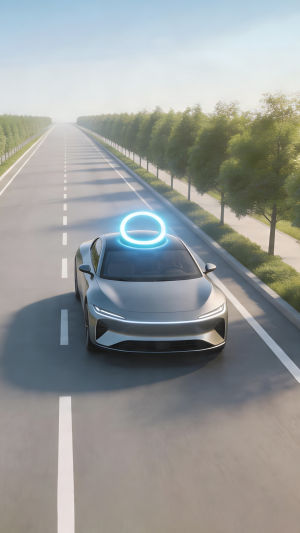
Autonomous driving technology is designed to help vehicles respond to road conditions automatically using sensors, cameras, radar, and artificial intelligence.
These systems aim to detect hazards early and adjust driving behavior to improve safety and reduce accidents.
<h3>Understanding Autonomous Vehicles</h3>
Autonomous vehicles use a combination of sensors, cameras, radar, and artificial intelligence to interpret their surroundings and make driving decisions without human input.
These systems continuously analyze the road environment, identifying nearby vehicles, pedestrians, and potential hazards in real time.
A key benefit of this technology is its ability to react quickly and consistently to traffic changes. Unlike human drivers, automated systems are not affected by distraction, fatigue, or delayed reaction times.
Autonomous systems are also designed to anticipate risks by analyzing movement patterns around the vehicle. For example, if a pedestrian is near a crossing area, the system can slow down in advance to reduce collision risk.
Overall, the purpose of this technology is to reduce human error and improve driving consistency.
<h3>Real-World Testing and Observations</h3>
Autonomous driving systems are evaluated through extensive road testing and simulation environments that replicate real traffic conditions.
Testing results show that these systems can operate for long distances under controlled conditions while maintaining stable performance. In many cases, incidents occur due to interactions with human-driven vehicles rather than system failure.
Simulation studies also show that autonomous systems can respond effectively to various scenarios such as sudden braking, lane changes, and complex urban traffic situations.
Overall findings suggest that safety performance improves as the technology continues to develop and refine.
<h3>Safety Improvements in Key Driving Scenarios</h3>
Autonomous systems can provide stronger safety performance in situations that require fast reaction and continuous monitoring.
- Rear-End Risk Reduction: Sudden braking and delayed reactions are common causes of rear-end collisions. Automated systems help reduce this risk by maintaining safe distances and responding quickly to traffic changes.
- Intersection Management: Intersections require accurate timing and decision-making. Autonomous systems can interpret signals and road conditions consistently, reducing the chance of errors.
- Driver Limitation Removal: Human factors such as fatigue, distraction, or reduced alertness are major causes of accidents. Autonomous systems remove these limitations by maintaining constant awareness.
<h3>Challenges and Ongoing Development</h3>
Despite strong potential, autonomous driving technology still faces several challenges.
A major challenge is operating safely in mixed traffic environments where human drivers behave unpredictably.
Another challenge is maintaining high performance in difficult weather and road conditions where sensor accuracy may be affected.
In addition, safety standards and regulations continue to evolve as the technology develops further.
These challenges show that while progress is strong, continued improvement is still required before full adoption becomes possible.
<h3>Future Outlook</h3>
As autonomous driving technology advances, systems are expected to become more reliable and capable of handling a wider range of driving conditions.
The long-term goal is to reduce traffic accidents by minimizing human error and improving consistency in driving decisions.
While full adoption will take time, current developments indicate steady progress toward safer and more efficient transportation systems.
Autonomous driving systems have strong potential to improve road safety by reducing human error, improving reaction time, and maintaining consistent awareness of road conditions. Continued research and development will play an important role in shaping their future impact on transportation safety.


