

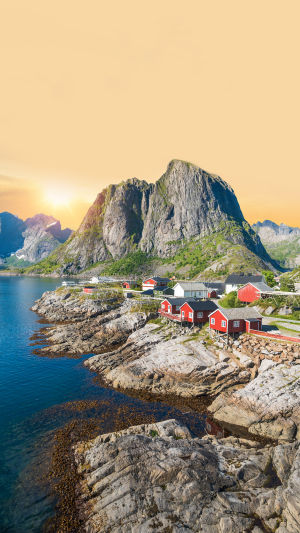
Lykkers, the Lofoten Islands look unreal at sunset: sharp mountains, quiet fishing villages, bright sea, and long golden light that stretches far beyond a normal evening.
But Lofoten is not a place where you should simply arrive, rent any vehicle, and chase every viewpoint. The distances look small, the roads are slow, the weather changes fast, and the best light often appears late.
For a first trip focused on panoramic sunset scenery, the strongest base is the western Lofoten area around Reine, Hamnøy, Sakrisøy, or Å. This gives you direct access to the most dramatic mountain-and-sea views, including Reinebringen for fit hikers and easier roadside viewpoints for travelers who want scenery without a steep climb.
For most Lykkers, 3 nights is the minimum smart stay. Two nights can work, but one rainy evening can ruin the whole sunset goal.
Lofoten
<h3>Plan the Arrival First</h3>
Lofoten rewards travelers who solve transport before choosing viewpoints. Public buses exist, but they are not frequent enough for a flexible sunset trip. If sunset scenery is your main goal, a rental car is usually the clearest yes.
<b>Choose the Best Entry Route</b>
There are three practical ways to enter Lofoten. First, fly to Leknes (closer to Reine and western viewpoints) or Svolvær (better for eastern Lofoten)—they're about 1 hour apart by road, but flights can be costly and often require connections.
Second, drive or take the bus from Narvik or Evenes—the Lofoten Express Bus follows the E10 route through Svolvær and Leknes, but Evenes Airport buses are limited, so check the Reis app before booking flights. For a sunset-focused first visit, the simplest plan is: ferry to Moskenes, arrange a car, and sleep near Reine for 3 nights. If flying to Leknes, allow ~1 hour by car to reach Reine in normal conditions.
<b>Stay in the Right Village</b>
Stay in Reine for the most famous mountain-and-fjord scenery; Hamnøy or Sakrisøy for red cabins, bridges, and water views close together; or Å for a quieter end-of-road feel. Avoid Svolvær if your main goal is Reine-area sunsets—the drive west can take 2 hours or more depending on stops, weather, and traffic.
Accommodation around Reine is limited, mostly rorbu cabins rather than hotels, so book early for June–August. For summer, 3 nights gives the best balance: arrival evening, one proper sunset attempt, one backup evening, and departure morning. If you can only afford 2 nights, don't plan the sunset viewpoint on your first night after a long travel day.
<h3>Build the Sunset Day</h3>
The word sunset needs special handling in Lofoten. From late May to mid-July, the sun may not properly set at all. Visit Lofoten places the Midnight Sun season around May 28 to July 14, with exact dates varying by location. Other Lofoten light guides use a similar late May to mid-July range.
That means your best sunset-style light depends on the month. For true sunset with warm evening color, choose August or September. For endless low golden light and a surreal midnight scene, choose late May through mid-July.
<b>Pick the Right Viewpoint</b>
Reinebringen is the most famous panoramic viewpoint near Reine, but it is not an easy stroll. Visit Norway describes it as a steep route with about 2,000 stone steps and up to 2 hours total for fit hikers. Other hiking guides estimate around 2.4 km return, about 458 m elevation gain, and 2 to 3 hours depending on pace, weather, and crowding.
Choose Reinebringen only if you are comfortable with steep steps, wind, exposed viewpoints, and a descent that may be slippery when wet. Start early enough to finish before you are tired and cold. For a sunset hike in August or September, begin 2.5 to 3 hours before sunset. This gives about 60 to 90 minutes to climb, 30 to 45 minutes at the viewpoint, and enough time to descend safely.
If the trail is wet, visibility is poor, or wind is strong, do not force it. Use easier viewpoints around Hamnøy, Sakrisøy, Reine, and Å instead. These roadside and village viewpoints are safer, faster, and still highly scenic.
<b>Parking and Timing</b>
Parking is one of the biggest Reine-area mistakes. Visit Norway directs drivers for Reinebringen to parking at Reine Ytre Havn, the outer harbour. Another hiking guide reports paid parking around NOK 25 per hour for regular cars and NOK 35 per hour for campers, but prices can change, so check the current machine or app before leaving the vehicle.
For summer, arrive at least 3 hours before your planned viewpoint time if hiking Reinebringen. That sounds early, but parking, restroom stops, clothing changes, and the walk to the trailhead all take time. If you arrive only 60 minutes before sunset, skip the hike and choose a lower viewpoint.
For a non-hiking sunset plan, arrive in Hamnøy or Sakrisøy about 90 minutes before the best light. Walk slowly, choose one or two photo positions, and do not drive between five locations during the same golden window.
<b>Daily Budget and Packing</b>
A realistic Lofoten day after accommodation is already paid may cost NOK 300 to 800 per person, depending on meals, fuel sharing, parking, and simple café stops. A lower-cost day means supermarket food, short drives, and paid parking only where needed. A higher-cost day includes restaurant meals and longer road movement.
Carry at least 1 liter of water per person for an easy viewpoint day, and 1.5 liters for Reinebringen or any longer walk. Bring a windproof layer, waterproof shell, warm mid-layer, hat, gloves, hiking shoes with grip, snacks, and a fully charged phone. Even in summer, sunset waiting can feel cold because wind comes quickly off the sea.
Lofoten does not need a crowded checklist. It needs weather patience, warm clothing, a safe route, and enough evenings for the sky to finally open.


