

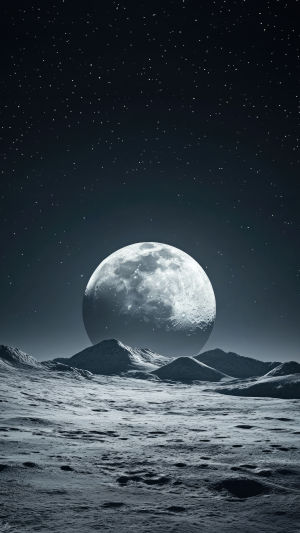
The Moon has been Earth’s companion for billions of years, influencing ocean tides and contributing to the stability of our planet’s environment.
However, the Moon is not permanently fixed in its orbit. It is gradually moving away from Earth through a natural process controlled by gravity, tidal interactions, and the exchange of energy between the two worlds.
Although this movement is almost impossible to notice during a human lifetime, it provides important evidence that planetary systems are constantly changing. The Earth-Moon relationship is a dynamic process that continues to evolve over vast periods of time.
<h3>Why the Moon Is Moving Away</h3>
The Moon’s outward movement is caused by tidal interactions between Earth and the Moon. The Moon’s gravity pulls on Earth’s oceans, creating tides, while Earth’s rotation causes these tidal bulges to move slightly ahead of the Moon’s position.
This small offset creates a gravitational interaction that transfers energy from Earth’s rotation into the Moon’s orbit. As the Moon receives this energy, its orbit expands and it slowly moves farther away. At the same time, Earth’s rotation gradually decreases, causing the length of a day to increase by a very small amount over long periods.
The Moon is currently moving away from Earth at approximately 3.8 centimeters per year. Scientists measure this gradual change through highly precise observations, allowing researchers to study how the Earth-Moon system changes over time.
<h3>The Role of Tidal Forces</h3>
Tidal forces are the result of differences in gravitational strength across an object. In the Earth-Moon system, these forces create a continuous exchange of energy that affects both bodies.
Because Earth rotates faster than the Moon completes its orbit, the tidal bulges are slightly displaced from the direct line between Earth and the Moon. This displacement creates a transfer of rotational energy that increases the Moon’s orbital distance.
This process is an example of how gravitational systems remain active rather than fixed. Even small interactions, repeated over millions of years, can gradually reshape the movement of celestial objects.
<h3>Effects on Earth</h3>
The Moon has a significant influence on Earth’s natural environment. Its gravity controls ocean tides and contributes to the long-term stability of Earth’s axial tilt, which affects patterns in the planet’s climate system.
As the Moon continues to move outward, its gravitational influence becomes slightly weaker. Over extremely long timescales, this could reduce tidal effects and alter the long-term evolution of Earth’s rotation.
The slowing of Earth’s rotation also provides scientists with valuable information about the planet’s past. By studying these changes, researchers can better understand how Earth has developed throughout its history.
<h3>The Future of the Earth-Moon System</h3>
Over an extremely distant future, continued tidal interactions could lead toward a state known as tidal locking. This occurs when the rotation period of one body matches the orbital period of another.
The Moon has already reached this condition with Earth, which is why the same side of the Moon is always visible from our planet. However, the complete synchronization of Earth and the Moon is not expected to occur because other influences, including the Sun, will affect the system’s long-term evolution.
The future of the Earth-Moon relationship remains a complex interaction between multiple gravitational forces, but its gradual transformation demonstrates the powerful role of physics in shaping space.
<h3>Why This Discovery Matters</h3>
The Moon’s slow movement away from Earth reveals that the universe is constantly changing. Objects that appear motionless from our perspective are still moving and interacting through invisible forces.
Understanding this process helps scientists study planetary evolution, orbital dynamics, and the long-term behavior of celestial systems. The Earth-Moon system serves as a natural example of how gravity can shape the history and future of worlds.
The Moon’s gradual retreat from Earth is a remarkable example of cosmic change happening on a timescale far beyond everyday experience. Through the interaction of gravity and tidal forces, Earth and the Moon continue to influence each other in a delicate gravitational relationship.
This slow movement reminds us that the universe is not static. Even the most familiar objects in the sky are part of ongoing processes that reveal the complexity and beauty of planetary evolution.


