

Black holes are among the most fascinating and extreme objects in the universe. Although they cannot be seen directly, their presence can be revealed through the powerful effects they create around them.
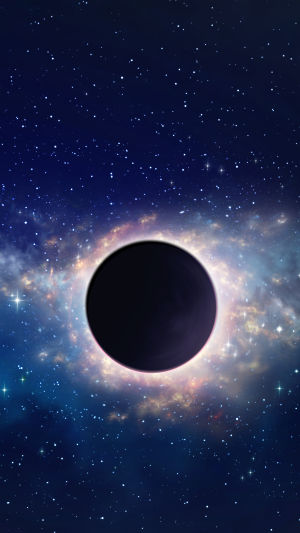
The image of a dark central region surrounded by a bright glowing ring represents one of the most remarkable features of these cosmic structures: intense gravity shaping the movement of matter and light.
Unlike ordinary objects in space, black holes contain an enormous amount of mass compressed into an incredibly small region. This creates a gravitational field so powerful that it changes the behavior of space and time around it. By studying these extreme environments, scientists gain valuable insights into the fundamental laws that control the universe.
<h3>The shadow and the glowing ring</h3>
The dark circular region at the center of a black hole image represents the black hole’s shadow. The black hole itself does not produce light because any light that crosses the event horizon, the boundary surrounding it, cannot escape.
The bright ring surrounding the shadow comes from superheated gas and dust moving around the black hole. This material forms a rotating structure called an accretion disk, where friction and intense gravitational forces generate enormous amounts of energy. The light from this region allows scientists to study the properties of black holes even though the objects themselves remain invisible.
<h3>How black holes are created</h3>
Many black holes form when extremely massive stars reach the final stages of their evolution. During this process, the star’s core can collapse under its own gravity after it can no longer maintain the pressure needed to support itself.
If the remaining mass becomes concentrated within a small enough area, gravity becomes strong enough to create a black hole. The result is a region where the curvature of space-time becomes extreme and the escape of light becomes impossible.
<h3>Gravity that bends light</h3>
One of the most extraordinary effects of black holes is their ability to influence the path of light. Their powerful gravity can bend light rays traveling nearby, creating distorted views of the surrounding environment.
This effect, known as gravitational lensing, reveals how massive objects can reshape the path of light through space. It also provides scientists with important evidence about the distribution of mass and gravity in the universe.
<h3>Black holes across the universe</h3>
Black holes exist in a wide range of sizes. Some are formed from collapsing stars and are known as stellar-mass black holes. Others are much larger and are found at the centers of many galaxies, containing millions or even billions of times more mass than the Sun.
These supermassive black holes influence the movement of stars, gas, and other material around them. Their role in the development of galaxies makes them important parts of the universe’s structure.
<h3>Studying invisible cosmic objects</h3>
Because black holes do not emit visible light, scientists study them by observing their effects on nearby objects. The motion of stars, the behavior of surrounding gas, and changes in radiation provide evidence about their size, mass, and activity.
Advanced observations allow researchers to create images of black hole environments by combining information from different forms of radiation and studying how gravity affects the surrounding space.
<h3>A laboratory for extreme physics</h3>
Black holes provide a unique environment for exploring some of the most important questions in physics. Their intense gravity allows scientists to investigate how space, time, and matter behave under conditions that cannot be easily recreated elsewhere.
Research on black holes continues to improve our understanding of gravity and the evolution of the universe. These objects are not simply mysterious regions of darkness; they are powerful sources of knowledge about the deepest processes shaping cosmic history.
The black hole shown in the image represents one of the universe’s most extraordinary phenomena. The dark central shadow, glowing surrounding material, and distant stars reveal the complex relationship between gravity, light, and matter. By studying black holes, scientists continue to uncover how the universe works at its most extreme limits, transforming these mysterious cosmic objects into valuable windows for understanding space itself.


