

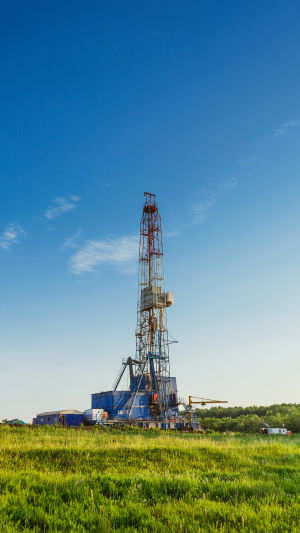
Hi, Readers! Digging into Earth sounds simple on paper—point the drill down, keep going, collect fascinating clues, and wave at science from the bottom.
In reality, it turned into a marathon through rock that behaved less like a tidy layer cake and more like a stubborn, overheated brick oven.
The Kola Superdeep Borehole, drilled on the Kola Peninsula in northwestern Europe, became the deepest artificial point ever reached on Earth. It pushed farther downward than any other drilling project, but the deeper the team went, the more the planet basically said, "That is far enough."
The project began as a scientific effort to study Earth’s crust in unusual detail. Unlike oil drilling, this hole was not meant to pull up resources. It was made to answer big geologic questions by bringing up rock samples, measuring temperature, and learning how the crust changes with depth.
Several boreholes were started at the site, but the main one, known as SG-3, became the record holder. It eventually reached a depth of about 12,262 meters, or roughly 40,230 feet. That is deeper than Mount Everest is tall, which is the sort of comparison that makes your brain pause mid-sip.
<h3>Why drilling had to stop</h3>
At first, the plan was to drill even deeper, with a target of about 15,000 meters. But Earth had other ideas. One of the biggest problems was heat. Scientists had expected high temperatures, but what they encountered was far hotter than planned, about 180 degrees Celsius at the deepest levels.
That kind of heat is brutal on drilling equipment and made the rock less stable and much harder to work with. Instead of acting firm and cooperative, the deep rock became more plastic in behavior, which is a fancy way of saying it started acting like it had no interest in holding still.
There were other problems too. The borehole was extremely narrow compared with its depth, which made the technical challenge enormous. Bits wore out, equipment struggled, and sections of the hole were damaged during drilling.
In the end, the combination of extreme temperatures, technical difficulty, and rising expense made the original goal unrealistic. Drilling stopped, and the project was later closed.
<h3>What scientists found</h3>
Even though the hole did not reach its planned depth, it still delivered a treasure chest of scientific information. One major surprise involved the structure of the crust.
Scientists had expected to hit a transition between granite and basalt at a certain depth, based on seismic data. But that expected boundary did not appear. Instead, they found metamorphic rock all the way down, which showed that the seismic readings had reflected changes in rock properties rather than a simple switch from one rock type to another.
Another striking discovery was water deep in the crust. It was not underground lakes sloshing around like in adventure stories. Rather, water was found in minerals and rock pores, released under the intense heat and pressure below the surface. That challenged assumptions about how water exists deep underground.
The project also turned up microscopic fossils in rock several kilometers down. These tiny remains of marine plankton were found in ancient rocks, offering evidence about the history of the region and how those rock layers formed. Scientists also detected hydrogen gas in the mud that came up from the borehole, another unexpected result that added to the project’s scientific value.
<h3>Why the hole still matters</h3>
The Kola Superdeep Borehole was abandoned as an active drilling project, but calling it a failure would be like calling a marathon useless because nobody kept running forever.
It set a depth record and gave scientists direct samples from parts of the crust that had never been reached before. It also reminded researchers that Earth is wonderfully rude to predictions. When you go deep enough, the planet stops being a textbook and starts becoming a trickster.
The site itself later fell into disuse, and the borehole was sealed. Still, its legacy hangs around in geology and drilling history. It remains one of the clearest examples of how exploration often works: you head out looking for one answer and come back with five surprises, a pile of broken tools, and a much deeper respect for what is under your feet.
So, what was found at the deepest hole ever drilled? Not the center of Earth, not a hidden underworld, and definitely not an easy victory. What scientists found was something better: real evidence that the crust is more complex, hotter, wetter, and stranger than expected. And why was it abandoned?
Because at extreme depths, heat, pressure, and engineering limits turned the whole project into a wrestling match with the planet, and the planet was clearly winning.


