

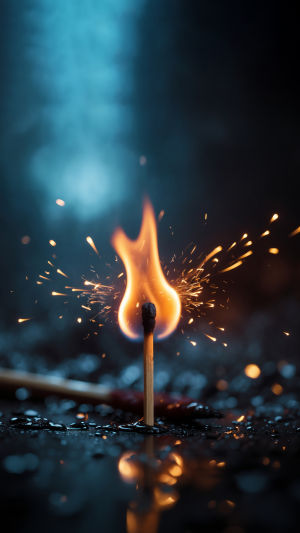
Fire has fascinated people for thousands of years, yet scientists continue to uncover new details about how flames behave.
Every spark represents a complex series of physical and chemical reactions that convert stored energy into heat and light. Modern research is helping scientists better understand combustion, improve fire safety, develop cleaner energy technologies, and reduce harmful emissions.
Although fire may appear simple, every flame depends on precise conditions. A small burning match demonstrates how chemistry, physics, and energy interact within seconds. Studying these processes has become increasingly important in fields ranging from materials science to environmental research.
<h3>How a Flame Begins</h3>
A match does not burst into flame on its own. Friction generates enough heat to trigger chemical reactions between the match head and the striking surface. Once the ignition temperature is reached, the chemicals react rapidly with oxygen in the surrounding air.
This process releases heat, which sustains the reaction and allows the flame to continue burning. As long as fuel, oxygen, and sufficient heat remain available, combustion continues.
<h3>The Chemistry Behind Combustion</h3>
Combustion is a rapid oxidation reaction that releases energy. During burning, fuel molecules combine with oxygen to produce heat, light, water vapor, and carbon dioxide when combustion occurs efficiently. The heat generated then vaporizes additional fuel, allowing the reaction to sustain itself.
Scientists carefully study combustion because improving its efficiency can reduce fuel consumption, lower emissions, and increase the performance of engines, power systems, and industrial processes.
<h3>Why Flames Have Different Colors</h3>
The color of a flame provides valuable information about temperature and combustion efficiency. A blue flame generally indicates more complete combustion with an adequate oxygen supply, while yellow or orange flames often result from glowing carbon particles produced during less complete combustion.
Researchers use advanced imaging techniques to analyze flame color, brightness, and movement. These observations help improve combustion systems used in manufacturing, transportation, aerospace, and energy production.
<h3>The Science Behind Flying Sparks</h3>
The bright sparks surrounding a burning match are tiny fragments of heated material that become incandescent as they travel through the air. Their size, temperature, and movement depend on the fuel composition, airflow, and combustion conditions.
Studying spark formation helps scientists better understand fire spread, ignition hazards, and combustion dynamics. This knowledge contributes to improved fire prevention strategies and safer industrial designs.
<h3>Why Fire Research Still Matters</h3>
Combustion science remains one of today's most active areas of research. Scientists are developing cleaner combustion technologies, designing fire-resistant materials, improving wildfire prediction models, and creating more efficient energy systems.
Modern computer simulations and high-speed imaging allow researchers to observe flames in extraordinary detail, revealing behaviors that were impossible to measure only a few decades ago. These advances continue to improve public safety while supporting innovation across engineering and environmental science.
Fire is far more than a source of heat and light—it is a remarkable example of chemistry and physics working together. From the instant a match ignites to the continuous reactions that sustain a flame, every stage of combustion reveals important scientific principles. Ongoing research is expanding our understanding of how fire behaves, leading to safer technologies, more efficient energy systems, and improved environmental performance. By exploring the science behind flames, researchers continue to unlock knowledge that supports innovation across many fields while deepening our understanding of the natural world.


