

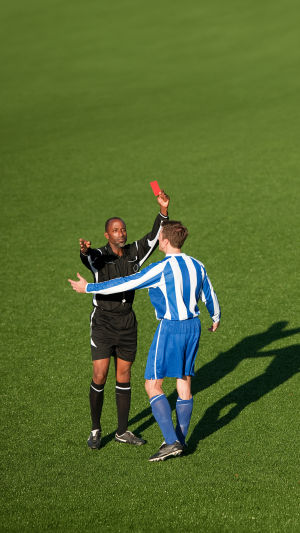
Hi, Readers! Football has always lived on speed, instinct, and split-second judgment, so bringing video review into that world was never going to feel small.
VAR, short for Video Assistant Referee, changed the rhythm of the game by adding a new layer of checking to moments that once passed in an instant. It did not replace the referee on the field, but it did reshape how key decisions are made, how players react, and how fans experience the match.
<h3>What VAR Is Meant to Do</h3>
VAR was introduced to help referees with clear and significant match incidents. Its purpose is not to reexamine every touch or interruption, but to focus on a limited group of decisions that can strongly affect the result. These usually include goals and the actions leading up to them, penalty decisions, direct red-card incidents, and cases of mistaken identity when a referee disciplines the wrong player. The video team reviews footage and communicates with the on-field referee, who can then keep the original call or change it after an on-screen review.
<h3>More Accuracy, Less Finality</h3>
One of the biggest changes VAR brought is a higher expectation of accuracy. A goal is no longer always a goal the second the ball goes in. A penalty shout no longer disappears the moment play continues. Decisions that once seemed final can now be paused, revisited, and corrected. This has reduced some obvious officiating errors, especially in situations involving offsides, fouls inside the area, and serious misconduct. At the same time, it has changed the emotional flow of football. Players may delay celebrations, and fans often wait a few extra moments before feeling certain that a major moment will stand.
<h3>How It Changed Match Tempo</h3>
VAR altered the pace of matches in a very visible way. Football traditionally moves with very few formal pauses, so review delays stand out immediately. Even short checks can interrupt momentum, cool a team’s pressure, or heighten tension in the stadium. Some supporters accept that pause as the price of better decision-making, while others feel that the waiting weakens the game’s natural energy. Either way, VAR made time itself feel different in football, especially during major incidents.
<h3>Fairness, Debate, and New Frustrations</h3>
VAR was meant to improve fairness, and in many cases it has done exactly that by catching errors that would previously have remained untouched. Still, it did not remove debate from football. In some ways, it simply shifted the argument. Supporters now discuss not only the referee’s call but also the review process, the camera angles used, the interpretation of contact, and the threshold for intervention. So while VAR can correct facts in some cases, it cannot fully erase disagreement in moments shaped by interpretation.
<h3>The Referee’s Role Still Matters</h3>
A common misunderstanding is that video review takes decision-making away from the referee. In practice, the referee remains central. VAR advises, checks, and recommends review, but the final decision often still belongs to the official on the pitch. That means technology supports officiating rather than replacing judgment. The human element remains, which is one reason discussions continue even after replay is shown from several angles.
<h3>A Different Experience for Everyone</h3>
VAR changed the experience of football for players, referees, coaches, and spectators. Players have become more aware that incidents can be reviewed after they happen. Referees work in closer coordination with off-field officials. Coaches and benches react differently when they know a decision may not be settled immediately. Fans, meanwhile, live through a more uncertain kind of drama, where celebration and frustration can both be delayed by a silent check or a long review at the monitor.
Football did not become a different sport because of VAR, but it did become a different viewing and decision-making experience. The technology improved the chance of correcting major errors, yet it also introduced pauses, tension, and fresh argument. That mix is why VAR remains one of the most discussed changes in modern football. What do you think, Lykkers, is a slower but more accurate game worth the trade-off?


