

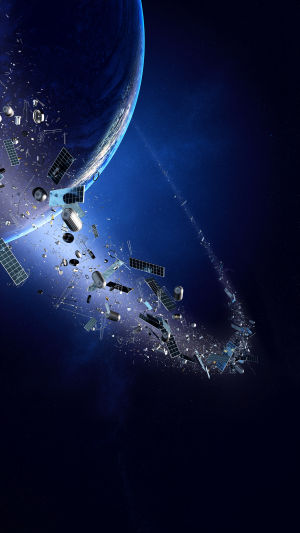
Lykkers! Every day, thousands of satellites orbit Earth, supporting navigation, communications, weather forecasting, scientific research, and global connectivity.
Yet alongside these essential spacecraft is a rapidly growing cloud of orbital debris that is making Earth's orbital environment increasingly crowded and hazardous.
Decades of launches, collisions, and abandoned spacecraft have left behind millions of pieces of debris, creating one of the greatest challenges facing the future of space exploration and satellite operations.
<h3>The Growing Cloud Around Earth</h3>
Space debris, also known as orbital debris, includes defunct satellites, spent rocket stages, fragments from collisions, and small pieces released during spacecraft operations. These objects continue orbiting Earth at speeds of about 17,500 miles (28,000 kilometers) per hour. At such extreme velocities, even a fragment only a few millimeters across can damage critical spacecraft systems, while larger objects can completely destroy operational satellites.
One of the greatest concerns is the Kessler Syndrome, a scenario proposed by NASA scientist Donald J. Kessler in 1978. It suggests that collisions between objects in orbit could create additional debris, triggering a chain reaction that increases the likelihood of further collisions. If left unchecked, this process could make some orbital regions significantly more hazardous for future space missions.
<h3>A Problem That Keeps Growing</h3>
According to the European Space Agency (ESA), more than 40,000 debris objects larger than 10 centimeters (about 4 inches) are currently tracked in Earth's orbit, while millions of smaller fragments remain too small to monitor individually. Although tiny, these fragments still travel at extremely high speeds and can pose serious risks to satellites and spacecraft.
The rapid expansion of satellite constellations for communications, navigation, and scientific research has increased the importance of careful space traffic management. Meanwhile, the International Space Station has performed numerous collision-avoidance maneuvers over the years to reduce the risk posed by orbital debris, demonstrating that this challenge already affects ongoing space operations.
<h3>Why It Matters on Earth</h3>
Orbital debris may seem distant, but its consequences can directly affect life on Earth. Modern society relies heavily on satellites for GPS navigation, telecommunications, weather forecasting, disaster monitoring, financial transactions, environmental observation, and internet services. Damage to these critical systems could disrupt essential services while increasing the cost, complexity, and risk of future space missions.
Protecting Earth's orbital environment is therefore not only a priority for astronauts and engineers but also an important part of maintaining the technologies that people depend on every day.
<h3>Efforts to Clean Up Space</h3>
Space agencies, research organizations, and private companies are developing technologies to slow the growth of orbital debris and remove existing objects from space. Proposed solutions include spacecraft designed to capture abandoned satellites, robotic servicing vehicles, nets, harpoons, and experimental laser systems intended to make small orbital adjustments that encourage certain debris objects to re-enter Earth's atmosphere safely. At the same time, many satellite operators now design missions with end-of-life disposal plans, allowing spacecraft to deorbit safely or move into designated disposal orbits after completing their missions.
Because Earth's orbit is a shared resource, reducing debris will require continued international cooperation, responsible satellite operations, improved space traffic management, and consistent adoption of debris-mitigation guidelines.
<h3>Looking Ahead</h3>
The growing cloud of orbital debris is a reminder that human activity extends far beyond Earth's surface. While space has enabled extraordinary scientific discoveries and technological progress, preserving the orbital environment has become essential for the future of exploration and global communications. Through responsible mission planning, improved tracking systems, effective debris-mitigation practices, and the development of active debris-removal technologies, the international community can help ensure that Earth's orbital environment remains safe, sustainable, and accessible for generations to come.


