

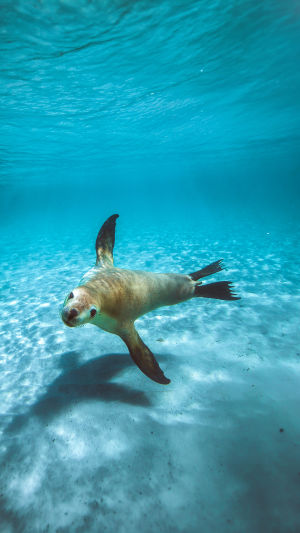
Good Day, Lykkers! Watching a sea lion glide through the ocean can feel almost effortless. It twists, dives, and accelerates with remarkable grace, moving far more like a bird in flight than a typical swimming mammal.
Despite spending time resting on beaches and rocky shores, sea lions are built primarily for life in the water. Every part of their body—from their flexible spine to their wing-like flippers—works together to create speed, agility, and endurance.
<h3>Wing-Like Front Flippers Provide the Power</h3>
Sea lions belong to the family Otariidae, commonly known as the eared seals. Their most distinctive swimming feature is a pair of long, muscular front flippers that function much like the wings of a bird. During each movement, the flippers sweep downward and backward through the water, and producing lift. This underwater "flight" is remarkably similar to how penguins and sea turtles move beneath the surface.
<h3>Hind Flippers Act Like Rudders</h3>
Although the front flippers supply most of the propulsion, the hind flippers remain equally important. Sea lions can rotate their rear flippers independently, adjusting their position to steer, brake, or stabilize the body during rapid maneuvers. These flippers function much like the rudder of a boat, helping the animal make tight turns while pursuing fish or navigating through underwater rock formations.
Unlike true seals, whose hind flippers are fixed behind the body, sea lions can rotate them forward beneath their torso. This adaptation not only improves movement on land but also provides exceptional control underwater. The combination of powerful foreflippers and highly maneuverable hind flippers allows sea lions to perform sharp directional changes that many predators and prey cannot easily match.
<h3>A Streamlined Body Reduces Resistance</h3>
Swimming efficiently requires more than strong muscles. Sea lions also possess a body shape designed to minimize drag. Their smooth, tapered form allows water to flow easily around the body, reducing resistance during movement. Short fur lies flat against the skin, while the neck, torso, and head blend into one streamlined profile that avoids unnecessary turbulence.
When swimming at higher speeds, sea lions often hold their body in a nearly straight line, limiting side-to-side motion and allowing the foreflippers to provide most of the propulsion. This streamlined posture conserves energy during long foraging trips. The result is a swimmer capable of sustained travel while remaining agile enough to react instantly to changing conditions.
<h3>Flexible Spines Improve Agility</h3>
One reason sea lions appear so graceful underwater is the remarkable flexibility of their spine. Their backbone bends easily, allowing smooth body movements that complement each flipper. During sharp turns, the flexible torso helps redirect momentum without sacrificing stability.
<h3>Swimming for Speed and Endurance</h3>
Sea lions are capable of impressive swimming performance. Depending on the species and situation, they typically cruise at moderate speeds while foraging but can accelerate dramatically when chasing prey or escaping danger. California sea lions, for example, commonly travel several kilometers during feeding trips and may reach burst speeds of around 25 to 30 kilometers per hour for short periods. Their efficient swimming style allows them to cover large areas of ocean without exhausting their energy reserves.
Because food sources often shift with changing ocean conditions, endurance is just as important as speed. A successful hunting trip may require hours of swimming before prey is located. Their cardiovascular system supports this lifestyle by delivering oxygen efficiently throughout the body, while specialized muscles store additional oxygen for extended dives.
<h3>Built for Diving as Well as Swimming</h3>
Swimming and diving work together in the daily life of a sea lion. Most feeding occurs beneath the surface, where sea lions pursue fish, squid, and octopus through different layers of the water column. During a dive, the heart rate slows naturally, reducing oxygen consumption while directing blood toward essential organs such as the brain and heart.
Most dives last only a few minutes, although healthy adults can remain underwater significantly longer when necessary. Their streamlined body, efficient propulsion, and oxygen-saving physiology allow repeated dives throughout the day with relatively short recovery periods at the surface. Excellent underwater vision and highly sensitive whiskers further improve hunting success by helping sea lions detect prey even in dim or murky water.
<h3>Swimming Style Reflects Their Evolution</h3>
The swimming technique of sea lions reflects millions of years of adaptation to marine life while retaining the ability to move effectively on land. Unlike whales, which became fully aquatic, sea lions continue to breed, rest, and raise their pups on shore. As a result, their anatomy represents a balance between terrestrial mobility and aquatic performance.
Their rotating hind flippers, powerful shoulders, streamlined body, and wing-like foreflippers create a combination rarely found in other marine mammals. This versatility allows them to thrive along coastlines where successful survival depends on both efficient swimming and confident movement across rocky beaches.
Sea lions do not simply swim—they fly through the water using techniques refined by evolution over millions of years. Every flipper, body twist, and graceful turn reflects an anatomy perfectly suited to life between land and sea. Their ability to combine speed, endurance, maneuverability, and diving efficiency has made them one of the ocean's most accomplished marine predators.


