

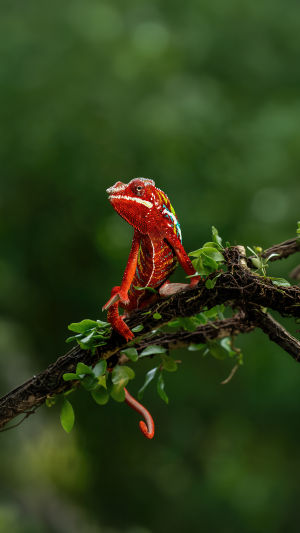
Hi, Readers! Chameleons seem almost magical when their skin shifts from green to yellow, blue, or dark brown in a short time.
Many people grow up hearing that they change color mainly to hide in the background, but that popular idea misses the real story.
Chameleons do sometimes become less noticeable in their surroundings, yet their color change is driven much more by communication and body regulation than by simple camouflage.
Their skin is an active display system, and it reflects what they are sensing and how their body is responding.
Chameleons are a distinctive group of lizards known for their grasping feet, long tongues, side-flattened bodies, and eyes that can move separately. They live mainly in Africa and Madagascar, with a few species found in parts of southern Europe and western Asia.
Their appearance already makes them unusual, but their skin is what captures the most attention. The key point is that color change is not just pigment moving around in a basic way. In many species, specialized skin layers help produce different visible effects.
<h3>How the color change works</h3>
Chameleon skin contains several kinds of cells that contribute to color. Pigment cells play a role, but structural changes in the skin are also important. In particular, iridophores contain tiny crystals that reflect light.
By changing the arrangement of these crystals, chameleons can alter which wavelengths of light are reflected, which changes the color people see. This means the process is not only about adding or removing dark pigment. It is also about physics, light, and skin structure working together.
This is why a chameleon can shift through a surprising range of shades depending on the species and situation. Some colors become brighter when the animal is alert or excited, while darker tones may appear when it is stressed or when it needs to absorb more heat.
The change can happen quite quickly, and it is controlled through the nervous system and hormonal responses. So when a chameleon changes color, it is often revealing its internal state rather than simply matching a leaf or branch.
<h3>Communication comes first</h3>
One of the most important reasons chameleons change color is communication with other chameleons. Males may display brighter or more contrasting colors when confronting rivals. During social encounters, color can signal readiness, dominance, or agitation.
In courtship as well, color patterns can communicate condition and intent. These displays are meaningful within the species, and they help reduce confusion during encounters.
Females also use color as a signal. In some species, a female may show particular colors that indicate whether she is receptive or not. This makes the skin a visible message board. Instead of thinking of color change as a trick for hiding, it is more accurate to see it as part of a social language. The colors are dynamic, responsive, and closely linked to behavior.
<h3>Temperature and light matter too</h3>
Color change also helps with thermoregulation. Darker colors absorb more heat, which can be useful in cooler conditions. Lighter colors reflect more light and may help prevent overheating.
Since chameleons rely on external heat sources to regulate body temperature, this ability can support daily survival. Their color patterns may therefore shift with sunlight, shade, or time spent resting and basking.
Light conditions can also affect how colors appear. A chameleon in bright light may look very different from the same animal in dim surroundings. That does not mean it is always trying to disappear.
Often, the visible shift is part body management, part signaling, and part response to the environment. Camouflage can happen, but it is not the whole explanation and usually not the main one people imagine.
<h3>Why the camouflage idea persists</h3>
The camouflage story remains popular because it is simple and visually convincing. If a chameleon on a branch looks green, it is easy to assume the animal turned green to copy the branch exactly. But nature is usually more complex than that.
Many chameleons spend much of their time in colors that reflect mood, status, temperature needs, and available light. Their skin is not just a background-matching tool. It is a flexible system shaped by multiple needs at once.
So the next time you see a chameleon change color, it helps to think beyond camouflage. The shift may be a social signal, a temperature response, or a reaction to stress and light. That richer explanation makes these lizards even more interesting. If you want to understand them better, watch not just the color itself, but the situation around it.


