

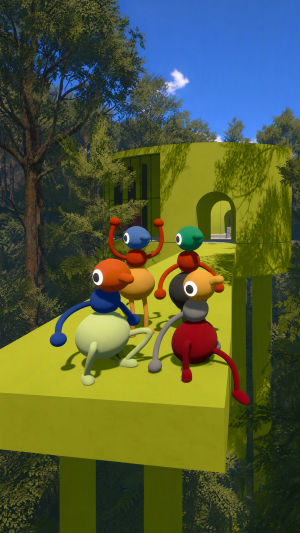
Big Walk understands something many online games forget: playing with friends can be entertaining even when nobody is chasing a leaderboard, collecting endless rewards or rushing toward the next objective.
Created by House House, the studio behind Untitled Goose Game, this cooperative adventure places players in a surreal open world inspired by the Australian landscape.
Sunsets glow over the water, valleys disappear beneath dense vegetation and unusual modernist structures rise from rocky ridges. The scenery is striking, but the real attraction is what happens when a group of players is dropped into it together.
<h3>Getting Lost Is Part of the Fun</h3>
Players control lanky, birdlike characters and can explore with up to 12 people. The terrain makes separation surprisingly easy. Thick bushes block visibility, cliffs interrupt routes and one wrong turn can leave somebody on the opposite side of the landscape.
The proximity-based voice system makes this much more entertaining. Friends become harder to hear as they move farther away, so finding someone may require shouting, signalling or using a walkie-talkie discovered during exploration.
A friend suddenly appearing in the distance with a flashing lamp can feel more memorable than completing an official objective.
<b>Big Walk turns getting lost into part of the entertainment rather than treating it as a mistake.</b>
<h3>Puzzles Depend on Cooperation</h3>
Exploration eventually leads to challenges ranging from straightforward physical tasks to puzzles that require everyone to stop joking for a moment and actually coordinate.
One challenge might involve launching a glowing spherical object through a hoop. Another asks players to arrange wooden pieces marked with mysterious symbols.
Completing tasks earns unusual red objects that can eventually unlock keys and new pieces of infrastructure, including a slow toy-like train whose horn is almost impossible to resist using unnecessarily.
The game rarely demands perfect execution. Characters move with deliberate awkwardness, objects wobble and carefully prepared plans often collapse within seconds.
That unpredictability gives the puzzles their charm. Success is satisfying, but failure can be much funnier.
<h3>The World Encourages Wandering</h3>
Big Walk also leaves plenty of space between its challenges.
Players spend a significant amount of time simply travelling through the wilderness, talking and deciding where to go next. The changing environment helps make these quieter moments enjoyable: daylight fades rapidly into star-filled nights, creeks run through valleys and distant sounds hint that something strange may be waiting nearby.
The world rarely explains itself completely. You might hear music somewhere inside a mountain or notice an odd structure in the distance without knowing whether it matters.
Following those distractions is often worthwhile.
The game feels most generous when it allows curiosity to replace instructions. Discoveries become shared stories rather than items checked off a map.
<h3>Walking Is the Weakest Part</h3>
The open structure does create one noticeable problem: backtracking.
Returning through the same stretch of terrain several times can become repetitive, particularly because basic movement is not especially exciting. Characters may also catch awkwardly on rocks or uneven ground.
These sections occasionally slow the game more than intended.
Fortunately, Big Walk understands that the journey is partly about conversation. A long walk gives friends time to joke about the previous disaster, argue about directions or notice something they missed earlier.
The repetition never disappears completely, but it rarely destroys the mood.
<h3>A Refreshingly Different Online Game</h3>
Many multiplayer games are built around constant progression. There are levels to gain, rewards to claim and notifications designed to keep players moving.
Big Walk largely steps away from that approach.
Its strongest rewards are social rather than numerical: solving something together, watching a friend fall spectacularly from a platform or discovering a ridiculous hidden area at the same moment.
One player can spend several minutes carrying an important object through a difficult section only to drop it at the final moment. In another game, that might produce genuine frustration. Here, it is often the story everyone remembers afterwards.
That emphasis makes Big Walk feel unusually relaxed. It is not trying to keep players permanently stimulated. It gives them space to create their own entertainment.
<h3>Who Will Enjoy It?</h3>
Players looking for competitive action, fast progression or a constant stream of challenges may find Big Walk too leisurely.
It is much better suited to groups that enjoy cooperative puzzles, exploration and physical comedy. Friends who already like talking nonsense while playing together will probably get the most from it.
The occasional repetitive journey and awkward movement keep the experience from being perfect, but they rarely overshadow its personality.
Big Walk is available on Nintendo Switch 2, PlayStation 5 and PC for approximately <b>€19</b>.
Ultimately, the game is less interested in where you are going than in what happens between destinations. <b>Its funniest and most memorable moments usually appear when a sensible plan collapses completely — and everyone decides the disaster was better than success.</b>


