

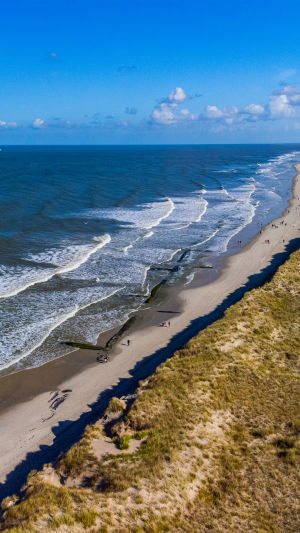
The seven inhabited East Frisian Islands stretch along Germany’s North Sea coast like a thin protective chain between the mainland and the Wadden Sea. Juist, Borkum, Baltrum, Langeoog, Spiekeroog and Wangerooge all share dunes, tidal flats and wide beaches, but each has a noticeably different personality.
What makes them especially interesting is their location inside the Wadden Sea UNESCO World Heritage area, one of Europe’s most important ecosystems for migratory birds.
More than 10 million birds use the wider Wadden Sea as a resting and feeding ground each year, making spring and autumn particularly rewarding for wildlife lovers.
<h3>1. Start With Norderney</h3>
Norderney is the easiest introduction to the islands because it combines nature with a lively town, good restaurants and comfortable hotels.
The island was one of Germany’s earliest North Sea resorts, and traces of that history remain in its old villas and spa architecture. At the same time, You are never far from dunes, salt marshes and beaches.
The best way to explore is by bicycle. Regular bikes can be rented from €8–10 per day, while e-bikes start at €20–25.
A particularly enjoyable route heads east from town through the dunes towards Weiße Düne and the island’s lighthouse. Eventually, cycling paths give way to protected quiet zones where visitors must continue on foot.
<b>Recommendation:</b> do not try to cover the entire island in one day. Ride east in the morning, stop for lunch near the beach, then return slowly with time for the dunes and viewpoints.
Norderney
<h3>2. Walk Across the Mudflats</h3>
The Wadden Sea looks completely different at low tide.
As the water retreats, huge stretches of seabed appear, revealing mud shrimp, crаbs, oysters, worms and salt-marsh plants. Even the surface can seem alive: thousands of tiny creatures beneath the mud create faint crackling sounds.
Guided mudflat walks are one of the most interesting experiences on the islands because the landscape is far more complex than it first appears.
Never attempt a long crossing independently. Tides return quickly, channels can fill unexpectedly and local guides understand which routes remain safe.
<b>Budget:</b> allow €10–20 for a guided nature walk and another €15–25 for lunch or refreshments afterwards.
<b>Recommendation:</b> bring clothes that can get dirty and expect to walk barefoot through soft mud. This is not the day for Your best shoes.
<h3>3. Slow Down on Langeoog</h3>
Langeoog offers a quieter experience and is completely car-free.
The island is known for its long sandy beach, which stretches for almost nine miles, grassy dunes and classic German beach chairs known as Strandkörbe.
These hooded wicker seats are surprisingly practical on the windy North Sea coast. On Norderney, a comparable beach chair costs from €14 per day when booked online, giving a useful idea of what to budget for a relaxed beach day in the region.
Langeoog is also an excellent place for birdwatching. Take binoculars and look for avocets, redshanks, sandpipers and geese around the wetlands and marshes.
Accommodation is more expensive than on the mainland. A stylish room close to the dunes can start around €141 per night.
<b>Recommendation:</b> visit in May, June, September or early October. You will encounter fewer summer crowds while still getting excellent wildlife viewing.
<h3>4. Discover Spiekeroog</h3>
For travelers who want the quietest atmosphere, Spiekeroog is one of the most appealing islands.
Cars are absent, the village retains traditional red-brick houses and the pace feels noticeably slower than on Norderney.
Instead of planning a long list of attractions, spend the day walking between the village, dunes and beach. This is an island where doing less actually improves the experience.
A comfortable daily budget is €50–80 per person excluding accommodation, covering meals, ferry transport and small activities.
<b>Recommendation:</b> stay at least one night. Day-tripping gives You the scenery, but the island becomes much more atmospheric once the last ferry crowds have gone.
<h3>5. Plan the Ferries Carefully</h3>
One important detail surprises many first-time visitors: despite appearing close together on the map, most East Frisian Islands are not connected by regular island-hopping ferries.
To move from one island to another, You usually return to the mainland and travel along the coast to a different ferry terminal.
Norderney is reached from Norddeich, with аdult ferry tickets from €13.50 each way when booked online. Bringing a bicycle costs another €8.20.
This makes it smarter to choose two or three islands rather than trying to visit all seven.
<b>Recommendation:</b> combine Norderney with one quieter island such as Langeoog or Spiekeroog over five to seven days.
<h3>How Much Should You Budget?</h3>
For a comfortable trip, allow €140–200 per day per person including accommodation.
A double room on Norderney can start around €160, while rooms on Langeoog begin around €141. Add €30–50 per person for meals, €10–25 for bicycle rental and around €25–40 for ferries and small activities.
Traveling outside peak summer can lower accommodation costs and also gives You better conditions for birdwatching.
<h3>Why These Islands Are Special</h3>
The East Frisian Islands are not really about ticking off landmarks. Their appeal comes from being exposed to the elements: wind across the dunes, changing tides, enormous skies and beaches that can feel almost empty beyond the main villages.
<b>For the best first trip, spend two or three nights on Norderney and another two on Langeoog or Spiekeroog. Cycle the dunes, join a guided mudflat walk, watch migrating birds and leave enough empty time in Your itinerary to simply follow the weather.</b>


