

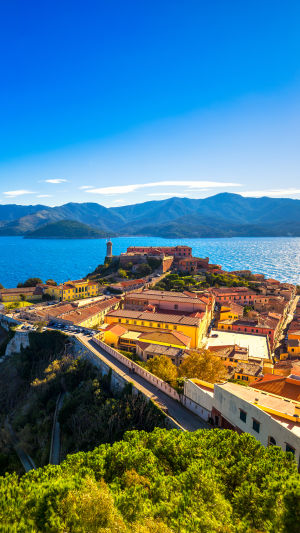
Tuscany usually means Florence, Siena and rolling inland hills. But just offshore lies a completely different version of the region: the Tuscan Archipelago.
Seven islands are scattered across the Tyrrhenian Sea, and five of the most accessible offer enough variety for an entire trip.
Elba has beaches and long hiking routes, Giglio feels compact and relaxed, Capraia is made for walkers, Pianosa is tightly protected, and Giannutri is almost entirely car-free and wonderfully quiet.
<b>The smartest way to explore them is not to rush through all five. Choose two or three and give each enough time to feel like an island rather than another stop on a checklist.</b>
<h3>1. Elba: The Easy Introduction</h3>
Elba is the largest island in the archipelago and the easiest place to start. Ferries from Piombino reach Portoferraio in roughly one hour, while faster services to Cavo can take about 20 minutes. September fares for two adults with a small car currently start at around €50 one way, although prices vary considerably by sailing.
Once there, you can combine beaches with sections of the 58 km Great Elba Crossing, one of the island’s defining hiking routes.
<b>Recommended budget:</b> €90–€150 per person per day with shared accommodation.
Stay at least three nights.
<h3>2. Giglio: Leave the Car Behind</h3>
Giglio works best for travelers who want something smaller and easier. Ferries leave from Porto Santo Stefano and take about one hour. Standard 2026 fares are roughly €14.50–€16 one way, plus a €3 landing tax between April and October.
Base yourself around Giglio Porto, then walk or use local transport to reach Giglio Castle and beaches such as Campese and Cannelle. The island’s scale is its advantage: you can spend the morning swimming, walk through medieval streets after lunch and still have time for a coastal path before sunset.
<b>Recommended budget:</b> €75–€120 per person per day.
<b>Recommendation:</b> two nights are enough for a relaxed introduction.
<h3>3. Capraia: For the Walkers</h3>
Capraia is the choice for travelers who would rather pack hiking shoes than beach clubs.
The island is rugged, mountainous and much less developed than Elba. Historic Genoese fortifications rise above the harbour, while trails lead toward coves and volcanic landscapes.
Most exploration happens on foot or by boat, which naturally keeps the pace slow.
This is not the island to choose if you want dozens of restaurants or nightlife.
<b>Best for:</b> hikers, couples and anyone actively looking for fewer facilities rather than more.
Allow two nights and budget around €80–€130 per person per day.
Capraia
<h3>4. Pianosa: The Protected Island</h3>
Pianosa feels completely different because access is deliberately controlled.
The flat island contains Roman remains, former prison buildings and unusually clear water, but much of the landscape can only be explored through authorized activities and guided visits. Cala Giovanna is the main freely accessible beach.
A guided full-day trekking experience currently starts from €35, excluding the ferry.
<b>Recommendation:</b> treat Pianosa as a day trip rather than trying to build an entire holiday around it.
Its restrictions are part of what keeps the landscape so distinctive.
<h3>5. Giannutri: Almost Nothing to Do</h3>
And that is precisely the attraction.
Giannutri is roadless, quiet and known for clear water, snorkeling and Roman archaeology, including the remains of Villa Domizia. Only Cala Maestra and Cala dello Spalmatoio are freely accessible for swimming.
Facilities are minimal, so bring water and anything else you need for the day.
Passenger boats operate from Porto Santo Stefano, but services are limited compared with larger islands.
<b>Best for:</b> a day of swimming, walking and deliberately doing very little.
<h3>How to Build the Trip</h3>
For a first visit, combine three nights on Elba with two on Giglio, then add Pianosa or Giannutri as a day excursion.
A six-day trip can realistically cost around €550–€850 per person before travel to Tuscany, depending on accommodation and ferry choices.
September is particularly appealing: the sea is still warm, temperatures are better for walking and the islands are calmer than in peak August.
<b>The Tuscan Archipelago works because each island has a different rhythm. Elba gives you choice, Giglio simplicity, Capraia wilderness, Pianosa history and Giannutri silence — all without leaving Tuscany.</b>


