

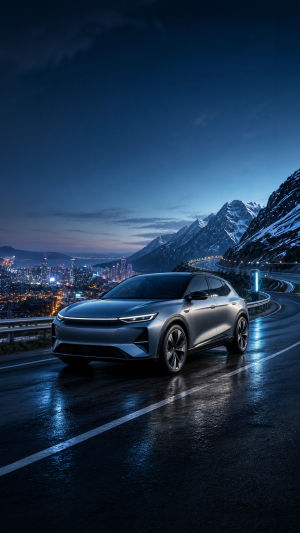
Europe is becoming one of the toughest car markets in the world, but Hyundai is not backing away. Instead, the Korean manufacturer and its premium Genesis division are preparing a large product offensive: 41 new or significantly refreshed models are planned for Europe by the end of the decade.
The strategy includes electric cars, combustion-powered models, hybrids and commercial vehicles, with several products designed specifically for European buyers. Hyundai wants to grow in Europe at a moment when some other Asian manufacturers are becoming more cautious about the region.
<h3>Electric Cars Take Priority</h3>
The biggest push will come from battery-electric vehicles. Hyundai wants annual EV sales in Europe to rise from about 116,000 units in 2025 to more than 420,000 by 2030.
That would represent an increase of more than three and a half times in only five years. One of the most important launches will be the Ioniq 3, a compact electric model built in Europe and expected to arrive later in 2026. It will be followed by a small electric SUV developed specifically for the European market, while a larger mid-size electric SUV is also planned.
These vehicles matter because affordable compact cars and crossovers remain some of Europe’s most competitive segments. Hyundai has also been slower than sibling brand Kia in bringing new EVs to market, so the upcoming launches are intended to close that gap.
<h3>Traditional Cars Are Staying Too</h3>
The plan is not exclusively electric. A new generation of the i20 hatchback is expected, based on technology connected with a recently introduced model for Brazil.
There is also a larger replacement for the Tucson, currently Hyundai’s best-selling model in Europe. <b>This mixed strategy reflects a practical reality: electric cars are central to future growth, but combustion engines and hybrids still contribute heavily to profitability.</b>
Hyundai has also indicated that the extended-range electric version of the Santa Fe could eventually reach Europe. This system uses electric drive but adds an engine to generate electricity, aiming to provide EV-like driving with much longer total range.
<h3>China Is the Bigger Threat</h3>
The scale of the expansion is closely tied to competition from Chinese manufacturers. European brands are already under pressure from companies able to produce electrified vehicles at lower cost. Hyundai says it has reduced battery costs for its next-generation EVs by around 30%, an important step if it wants to compete more aggressively on price.
That matters because lower battery costs can make smaller electric cars more profitable without forcing manufacturers to rely entirely on expensive premium models.
The company’s CEO, José Muñoz, has described Europe indirectly as one of the world’s most competitive regions, reinforcing why cost control has become such a major priority.
<h3>Genesis Wants More Attention</h3>
Genesis will form another part of the strategy. The luxury brand has struggled to gain the same visibility in Europe as established premium rivals, but its footprint is expanding.
In 2026, Genesis added several European markets, while further expansion is planned across Austria, Denmark, Poland and Portugal. Globally, the brand is preparing the GV90 luxury electric SUV, a hybrid GV80 and an extended-range electric SUV expected in 2027 with more than 1,000 km of total range.
Not all of these models have been confirmed for Europe, but the region is expected to remain an important target for electrified Genesis products.
<h3>More Choice Is Coming</h3>
The figure of 41 does not mean 41 completely new nameplates. It includes both entirely new cars and major updates to existing models. Even so, the scale of the programme is significant.
<b>For European buyers, the result should be a much broader Hyundai and Genesis range, especially among compact EVs, SUVs and hybrids.</b>
For Hyundai, however, the strategy is about more than filling showrooms. It is a bet that Europe is still worth fighting for — even as Chinese manufacturers become faster, cheaper and increasingly difficult to ignore.


