

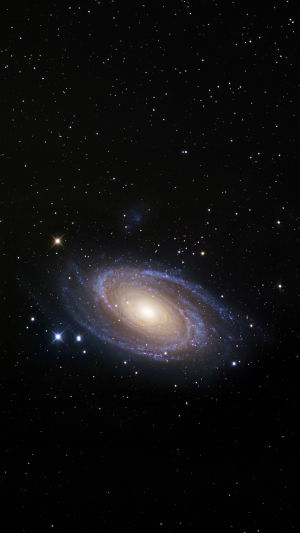
Spiral galaxies are among the most recognizable structures in the universe.
Their rotating disks contain stars, gas, and dust surrounding a dense central region, while curved arms extend through the disk.
These arms are dynamic patterns shaped by gravity, orbital motion, and changes in the distribution of matter.
<h3>Inside a Spiral Galaxy</h3>
A spiral galaxy generally consists of a flattened rotating disk surrounded by a more extended region of stars and other matter. The disk contains stars of different ages, gas, and dust, while the central area contains a much greater concentration of stars.
Spiral arms are regions where material is more concentrated than in neighboring areas. They frequently contain gas, dust, and active star-forming regions, where young stars can make the arms especially prominent in astronomical observations.
The material within an arm does not necessarily remain there. Stars and gas continue along their individual orbits while the larger spiral pattern develops and changes. An arm is therefore better understood as a large-scale structure within the disk rather than a permanent trail containing the same objects.
<h3>Rotation Shapes the Disk</h3>
Stars and gas orbit the galactic center, but their orbital speeds vary with distance. This differential rotation strongly influences spiral structure.
If spiral arms were simply fixed collections of material, differential rotation would gradually stretch them and wind them increasingly tightly. This creates the well-known winding problem: a purely material pattern would not remain recognizable for very long compared with the age of a galaxy.
Gravity provides an important part of the explanation. The combined gravitational influence of matter within the disk can strengthen variations in its distribution, allowing organized spiral patterns to develop.
<h3>Density Patterns and Star Formation</h3>
One explanation for spiral structure involves density patterns moving through the disk. These patterns can rotate at a different rate from the individual stars and gas clouds that pass through them.
When gas encounters a denser region, it can become compressed, creating conditions that favor new star formation. This contributes to the bright and structured appearance of many spiral arms.
The key distinction is between material motion and pattern motion. Individual stars and gas clouds can move through a spiral feature while the larger pattern remains identifiable. This allows an arm to exist without being made up of one permanent group of stars.
Not every spiral galaxy follows the same long-lived pattern. Observations and simulations indicate that some spiral features are temporary and can change substantially over time.
<h3>Temporary Spiral Features</h3>
Small disturbances within a rotating disk can sometimes grow into more pronounced spiral structures. One process involved in this development is swing amplification, in which differential rotation stretches a disturbance while the disk's own gravity strengthens it.
The resulting features can grow, weaken, merge, or disappear. New disturbances may subsequently produce additional structures. Through this continuing activity, a galaxy can retain an overall spiral appearance even though individual arms are not permanent.
This dynamic behavior complements models involving longer-lasting density patterns and helps explain the variety of spiral structures observed in galaxies.
<h3>Central Structures and Spiral Arms</h3>
Some spiral galaxies contain elongated structures in their central regions. These features can influence the movement of stars and gas throughout the disk and affect the development of surrounding spiral patterns.
Their relationship with spiral arms varies between galaxies. In some systems, the central structure and arms appear closely connected, while in others, the spiral features are influenced more strongly by processes elsewhere in the disk.
This variation demonstrates that spiral structure can develop through several interacting mechanisms rather than following one universal pattern.
<h3>Gravitational Encounters</h3>
A galaxy can also be influenced by the gravitational field of a nearby galaxy. An encounter can disturb the disk and generate or strengthen organized spiral features, sometimes producing particularly prominent two-arm patterns.
The outcome depends on factors such as the masses of the galaxies, their relative positions, and the geometry of the encounter. Internal gravitational processes can then continue reshaping the disk.
Spiral structure can therefore reflect both the internal behavior of a galaxy and the gravitational environment surrounding it.
<h3>Observing Spiral Arms</h3>
Astronomers study spiral galaxies using observations across multiple wavelengths. Visible light reveals many stars and prominent dust structures, while infrared observations provide additional information about stars and dust that are less apparent at shorter wavelengths. Radio observations help trace important components of interstellar gas.
Researchers also measure stellar and gas motions, examine the geometry of spiral arms, investigate star-forming regions, and study how quickly different patterns rotate. These observations can be compared with computer simulations to evaluate different explanations for spiral structure.
Because several processes can produce similar visual features, astronomers rely on multiple forms of evidence rather than judging the origin of an arm from its appearance alone.
<h3>Why Spiral Galaxies Look Different</h3>
The variety of spiral galaxies reflects differences in their internal conditions and surroundings. Some display broad, well-defined arms, while others have fragmented or irregular structures. Gravitational disturbances, disk instabilities, central structures, and the distribution of gas can all influence these differences.
Spiral structure can change as the balance among these processes evolves. The result is a diverse collection of galaxies with distinct patterns and characteristics.
<h3>A Dynamic Cosmic Pattern</h3>
Spiral arms demonstrate how large-scale structures can emerge from the interaction between motion and gravity. Material continuously travels through the disk while gravitational processes shape the patterns that appear within it.
Some spiral features may persist for relatively long periods, whereas others can form and fade repeatedly. Internal dynamics and gravitational encounters can further modify the structure, creating the wide range of forms observed across spiral galaxies.
Spiral arms are dynamic patterns created by the complex behavior of rotating galactic disks. Their structure can be influenced by differential rotation, gravity, density variations, disk instabilities, and gravitational interactions.
By studying the movement of stars and gas and comparing observations with physical models, astronomers can investigate how these patterns form and evolve. The elegant spiral shape of a galaxy is therefore more than an impressive image—it is a visible expression of the gravitational dynamics governing its enormous rotating disk.


