

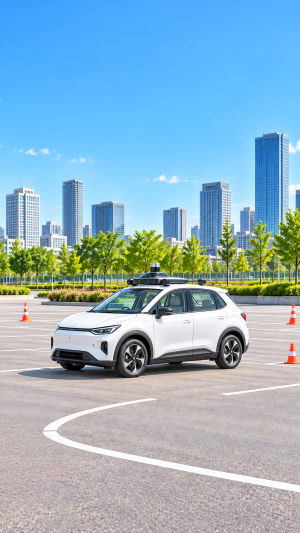
London’s first commercial robotaxi services are bringing autonomous driving into everyday transport, but the person sitting behind the wheel still has an important role. Human safety drivers must monitor the vehicle, recognise when something has gone wrong and be prepared to take control within seconds.
That arrangement sounds reassuring. Yet it creates a subtle problem: the more capable the automated system becomes, the less often the human actually drives. Over time, the very skills needed in an emergency may become harder to maintain.
<h3>Automation Changes The Human Role</h3>
Driving is not simply a matter of steering and braking. It involves continuously reading traffic, predicting what other road users may do, judging risk and responding to unexpected situations.
In a robotaxi, much of that work moves to software. The human does not necessarily become irrelevant, but the job changes dramatically. Instead of actively controlling the car, the safety driver becomes a supervisor whose most important task may occur only when the automated system encounters something unusual.
This problem has been recognised for decades. In 1983, psychologist Lisanne Bainbridge described an “irony of automation”: machines tend to take over routine tasks while leaving humans responsible for the rare, difficult situations that automation cannot manage. The difficulty is that removing routine practice can also weaken the human expertise needed for those exceptional moments.
<h3>Less Practice Can Mean Less Readiness</h3>
The concern is not limited to driving. Evidence from other highly automated settings suggests that human performance can change when people become accustomed to relying on machines.
A 2025 study involving clinicians using AI-assisted colonoscopy found that their unaided detection of precancerous growths declined after regular exposure to the technology. Detection without AI fell from 28.4% before routine use to 22.4% afterwards.
The finding does not prove that automation inevitably makes professionals worse at their jobs. Instead, it highlights an important distinction: <b>a human-machine system can improve overall even while the human operator gets less practice performing the task independently.</b>
For robotaxis, that distinction matters because a safety driver may spend long periods simply observing, then suddenly be expected to make a fast and accurate decision.
<h3>Being Present Is Not Enough</h3>
The idea of keeping a “human in the loop” is common across transport, medicine and other AI-assisted industries. But physical presence alone does not guarantee meaningful oversight.
A supervisor needs enough expertise to identify when a system is behaving incorrectly, enough situational awareness to understand what is happening and enough confidence and authority to intervene.
Separate autonomous-driving research has shown why this can be difficult. Tests of an explanatory system developed by MIT and Motional found that safety drivers could sometimes misunderstand why a self-driving vehicle had stopped or made a particular decision. Providing clearer explanations helped drivers anticipate the vehicle’s behaviour and intervene earlier when necessary.
<h3>London Becomes A Real-World Test</h3>
Uber and British autonomous-driving company Wayve launched a small London robotaxi service in September, initially using fewer than 20 vehicles with human supervisors on board. Customers can be matched with an autonomous vehicle through the Uber app and may accept or decline the ride.
Britain’s regulatory framework distinguishes these supervised trials from services operating without a safety driver. Under current government guidance, supervised testing requires a trained driver who is ready, able and willing to resume control at any time. Fully driverless passenger services must go through a separate approval and permitting process.
This means the safety-driver role may itself prove transitional. Robotaxis already operate without onboard supervisors in parts of the United States and China, while Britain is moving gradually towards a framework for similarly driverless passenger services.
<h3>The Bigger Question About Automation</h3>
The issue extends far beyond taxis. As software increasingly performs routine professional tasks, humans may spend more time monitoring systems and less time practising the underlying skills themselves.
That creates a new challenge for automation: designing jobs so that people remain capable of taking meaningful control rather than simply watching technology work.
For autonomous transport, safety may therefore depend on more than improving the car. It may also require training, regular hands-on practice and systems that help supervisors understand what the vehicle is doing. <b>The crucial question is not simply whether a human remains in the driver’s seat, but whether that person is still prepared to act when the technology needs them most.</b>


