

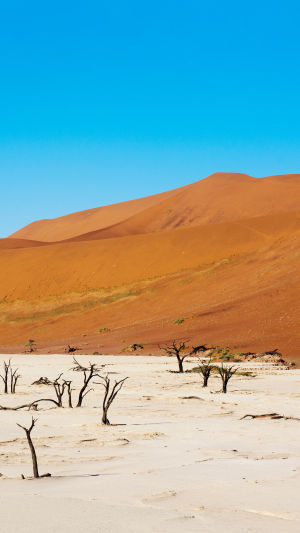
Lykkers, imagine walking across a bright white clay pan surrounded by towering orange dunes, with dark tree trunks standing motionless against a deep blue sky.
Deadvlei is one of Namibia's most distinctive landscapes, and its unusual appearance comes from a natural story that unfolded over centuries.
The combination of ancient trees, dry clay, and enormous dunes makes this a destination that feels completely different from an ordinary desert excursion.
<h3>What Makes Deadvlei Special?</h3>
Deadvlei is a dried clay pan within the Sossusvlei area of Namib-Naukluft National Park. The trees found here are believed to be around 700 years old. They once grew when water from the Tsauchab River reached the area, creating conditions suitable for vegetation.
Over time, the river's course changed and the area became extremely dry. The trees died, but the exceptionally dry conditions prevented them from decomposing in the usual way. Their dark trunks now contrast sharply with the pale clay floor and orange dunes surrounding the pan.
<h3>Walk Across the Clay Pan</h3>
One of the best things about Deadvlei is that there is no complicated activity schedule. Visitors can walk across the pan at their own pace, photograph the trees, and enjoy the unusual landscape. From the designated parking area, the walk to Deadvlei takes roughly 15 minutes.
Other current visitor guidance places the distance at a little over one kilometre, depending on the exact parking point. The route crosses soft sand and has no natural shade, so comfortable footwear and drinking water are essential.
Namib Desert
<h3>Climb Big Daddy</h3>
If you want to make the visit more active, Big Daddy provides an impressive challenge beside Deadvlei. The dune rises about 325 metres and is considerably more demanding than the smaller Dune 45. Climbing soft sand requires more effort than walking on a firm trail, so allow plenty of time and avoid rushing.
Early morning is particularly suitable because temperatures are generally more comfortable and the light creates strong contrasts across the dunes.
<h3>Visit Dune 45 and Sossusvlei</h3>
Deadvlei is only one part of the wider Sossusvlei landscape. Dune 45 is another popular stop and rises about 80 metres above the surrounding plain. Its accessible location makes it a practical choice for visitors who want a shorter dune climb.
The actual Sossusvlei pan is nearby and is associated with the Tsauchab River. Although water is uncommon, occasional wet conditions can transform the normally dry landscape. Sesriem Canyon is another worthwhile stop closer to the park entrance and can be explored as part of the same day.
<h3>Entrance Fee and Park Hours</h3>
For international visitors, the entrance and conservation fee for Namib-Naukluft National Park is US$17 per person per day. A vehicle fee is charged separately. The government fee schedule lists US$3.70 for a vehicle carrying up to 10 seats. The outer Sesriem gate generally operates from sunrise to sunset. Visitors staying inside the park can access the inner gate earlier, which can be useful for reaching the dunes around sunrise.
<h3>Getting to Deadvlei</h3>
A 4x4 vehicle is the practical option for the final sandy section toward Deadvlei. Visitors travelling in a regular 2x4 vehicle can leave it at the designated parking area and use the shuttle service. Namibia Wildlife Resorts currently lists the shuttle from the 2x4 parking area to Deadvlei at US$11 per person. The same operator lists guided morning drives at approximately US$37.
<h3>When to Go</h3>
The cooler months are generally comfortable for exploring the desert, while early morning is particularly attractive for photography and walking. Sunrise brings softer light and long shadows across the clay pan. Regardless of season, bring plenty of drinking water, sun protection, sunglasses, and a hat. The combination of intense sunlight and limited shade means preparation matters even when the temperature feels pleasant at first.
Deadvlei is memorable because its beauty comes from contrast. Give yourself enough time to walk beyond the first viewpoint, notice how the light changes, and experience the silence of the pan.


