

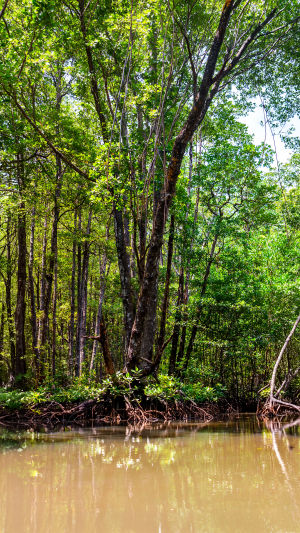
Mangrove forests provide essential protection for tropical and subtropical coastlines, helping reduce wave energy, prevent erosion and support marine ecosystems. Yet restoring these valuable habitats has proved surprisingly difficult, even in areas where conditions initially appear suitable.
A new international study published in Nature reveals that the success of mangrove restoration depends heavily on brief periods of calm water. The findings could help conservation teams identify suitable planting locations and improve the effectiveness of coastal restoration projects.
<h3>Why Mangrove Restoration Often Fails</h3>
Mangroves are remarkably effective natural coastal barriers. Their dense root systems slow water movement, reduce the impact of waves and help stabilise shorelines. However, young mangrove trees are extremely vulnerable to the same forces that mature forests can withstand.
Strong waves, tidal currents and shifting sediments can uproot seedlings before their roots become firmly established. Researchers explain that restoration projects often rely on average environmental conditions when selecting planting sites. This approach can overlook short periods of intense wave activity that determine whether newly planted trees survive.
<h3>What The Global Study Discovered</h3>
An international research team examined 20 years of wave records from approximately 400 coastal locations worldwide. Around half of the sites contained mangrove forests, while the remaining locations had no mangroves. The researchers combined these observations with experimental findings about how seedlings respond to wave exposure during their early development.
Their model correctly predicted the presence or absence of mangroves at more than 75% of the locations studied. The results showed that coastlines supporting mangroves generally experience longer and more frequent periods of low wave energy. These calmer conditions give seedlings enough time to develop roots capable of resisting stronger waves.
<h3>Why The First Months Matter</h3>
The study identified a particularly important period during the earliest stages of mangrove growth. A newly established seedling can tolerate very little wave movement. However, its resistance increases rapidly as its root system develops. After just one week, a young plant can withstand wave conditions that would have uprooted it immediately after establishment.
The greatest improvement in resistance occurs during the first three months. Scientists describe these favourable periods as windows of opportunity, when environmental conditions allow seedlings to become securely anchored.
Understanding when these windows occur could improve the timing and location of restoration efforts.
<h3>Climate Change Creates New Challenges</h3>
Changing climatic conditions could alter where mangrove forests can successfully regenerate.
Wave direction is particularly important because even small changes in the angle at which waves reach the coastline can influence seedling survival.
Some areas currently supporting mangroves could become less suitable for new growth, while previously unsuitable coastlines might develop more favourable conditions.
However, wave exposure is only one factor affecting mangrove distribution.
Sea-level rise, temperature, salinity, tides and sediment availability also influence where these forests can grow.
<h3>How The Findings Could Improve Conservation</h3>
The research offers practical guidance for organisations investing in mangrove restoration.
Instead of selecting planting locations using average wave conditions alone, conservation teams could assess how frequently suitable calm periods occur.
This approach may help identify coastal areas where young trees have a better chance of surviving their earliest stages.
The findings also highlight an important challenge: coastlines most in need of protection from powerful waves may be among the hardest places to establish new mangrove forests.
By improving planting strategies and recognising the importance of early growth conditions, restoration projects could become more effective at protecting coastal communities and preserving valuable ecosystems.


