

Namibia's Erongo Region brings together landscapes that seem remarkably different: rugged granite mountains, dry inland plains, and the cool Atlantic coastline. Traveling between them reveals how dramatically the country's scenery can change within a few hours.
Quiver trees are among Namibia's most distinctive desert plants, but they are not found everywhere in the Namib. For a rewarding Erongo road trip, focus on the region's mountain scenery, accessible desert routes, and coastal stops. These six recommendations combine three landscapes, two restaurants, and one mountain lodge.
<h3>Quiver Trees in Namibia</h3>
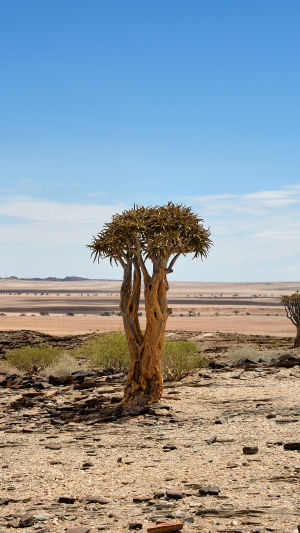
Quiver trees are among Namibia's most recognizable desert plants. Despite their appearance, they are not conventional trees but large, branching aloes, now commonly classified as Aloidendron dichotomum.
Their pale trunks and distinctive crowns help them survive in dry, rocky environments. Mature specimens can reach several meters in height, creating striking silhouettes against the surrounding landscape.
The name comes from the historical use of hollowed branches as containers for arrows by some Indigenous communities.
However, travelers should not expect to find extensive quiver tree forests throughout Namib-Naukluft National Park. The country's best-known quiver tree landscapes are concentrated farther south, particularly near Keetmanshoop.
The Quiver Tree Forest near Keetmanshoop is a well-established destination, but visiting it requires a substantial detour from an Erongo road trip. Travelers particularly interested in photographing these plants should consider adding southern Namibia as a separate part of their itinerary.
Quiver trees grow slowly and are vulnerable to environmental pressures, so visitors should admire them without disturbing their trunks, branches, or surrounding soil.
<h3>Erongo Mountains</h3>
The Erongo Mountains offer a dramatic change from Namibia's coastal plains. Their rounded granite formations, rocky valleys, and scattered vegetation create a landscape shaped by ancient volcanic activity and long periods of erosion.
This is a rewarding area for travelers interested in geology, photography, and quiet natural surroundings.
The mountains lie inland from Swakopmund, with Usakos serving as one of the main access towns. From Swakopmund, the drive to Usakos is approximately 150 kilometers along the B2 highway, usually taking around two hours under normal conditions.
Beyond the main roads, access to individual lodges and walking areas may involve gravel tracks. Some trails cross private land or protected properties, so permission or a guided excursion may be necessary.
Early mornings and late afternoons are particularly attractive for photography, when lower sunlight emphasizes the shapes and textures of the granite formations.
Wildlife sightings are possible, but they depend on the location, season, and time of day. Visitors should not approach animals or leave marked routes without local guidance.
<h3>Namib-Naukluft National Park</h3>
Namib-Naukluft National Park protects an extraordinary range of desert environments, from gravel plains and rugged mountain terrain to some of the Namib's most famous sand dunes.
Its size makes careful planning essential. The park extends across a vast area, and its principal attractions are separated by considerable driving distances.
The best-known dune landscapes lie around Sossusvlei and Sesriem, well south of the Erongo Mountains. They should not be treated as a short excursion from Usakos or Swakopmund.
For visitors entering the Sossusvlei area, Sesriem is the principal gateway. From Swakopmund, the journey is roughly 350 kilometers or more, depending on the route, and commonly requires five to six hours or longer on a combination of paved and gravel roads.
International visitors should budget for park entrance charges in Namibian dollars. Fees vary by visitor category and vehicle type, and official tariffs should be checked before departure rather than relying on older online estimates.
Desert driving requires adequate drinking water, fuel, sun protection, and a reliable vehicle. Mobile coverage can be limited, while temperatures and road conditions change considerably between the coast and the interior.
Travelers unfamiliar with gravel-road driving may prefer a guided excursion, particularly when visiting remote areas.
Namib-Naukluft National Park
<h3>The Tug Restaurant</h3>
The Tug is one of Swakopmund's distinctive dining landmarks, occupying a converted vessel beside the town's historic jetty.
Its position overlooking the Atlantic Ocean makes it an appealing stop after a journey through Namibia's inland landscapes. Large windows provide coastal views, while the maritime setting gives the restaurant a character of its own.
Seafood is a central feature of the menu, with fish dishes reflecting the importance of the Atlantic coast to Namibia's food culture. Other choices may be available for diners with different preferences.
A main course at an established coastal restaurant in Swakopmund can cost approximately 180–450 Namibian dollar, depending on the dish. This is a general planning range rather than a confirmed current price for The Tug.
The restaurant is especially popular during busy holiday periods, so reserving a table is sensible if you have a preferred dining time.
Its location near the waterfront also makes it convenient for combining a meal with a walk along Swakopmund's seafront.
<h3>Fishy Corner</h3>
Henties Bay offers a quieter coastal stop north of Swakopmund, and Fishy Corner is associated with straightforward seafood meals in an informal setting.
The town is approximately 70 kilometers north of Swakopmund along the C34 coastal road, making it a manageable addition to a day exploring the Atlantic shoreline.
Fish and chips are a natural choice for travelers seeking a filling meal without an elaborate dining experience. Takeaway service may also be convenient for those continuing along the coast.
For a casual seafood lunch in the area, allowing around 120–250 Namibian dollars per person is a useful starting budget, although portion sizes and current menu prices should be confirmed locally.
Henties Bay is known for its coastal scenery and fishing culture. The cooler temperatures can be a welcome contrast after time inland, but sea fog and strong winds are common enough to make a light jacket useful even on sunny days.
Restaurant opening hours can vary, so travelers planning a late lunch should check that the kitchen is still serving before making the drive.
Henties Bay
<h3>Hohenstein Lodge</h3>
For travelers who want to spend more time among the Erongo Mountains, Hohenstein Lodge provides a base away from the larger towns.
The lodge lies in the Usakos area, approximately 25–30 kilometers from town, although the precise driving distance depends on the access route.
Its setting near the mountain slopes is the main attraction. Guests can enjoy broad views of the surrounding granite formations, particularly as the light changes toward sunset.
Accommodation is described as comfortable and suited to visitors seeking a peaceful stay. The property also offers dining facilities and an outdoor swimming pool, making it possible to spend a relaxed afternoon at the lodge between excursions.
Rates vary by season, room category, and meal arrangements. As a broad guide, established scenic lodges in the Erongo area may cost approximately 2,000–4,000 Namibian dollar or more per room per night. Confirm the lodge's current rates and whether meals are included before booking.
A vehicle is generally the most practical way to reach the property. Ask for detailed directions in advance, as the final approach may involve gravel roads and limited roadside signage.
The Erongo and Namib-Naukluft regions reward travelers who take their time. The quiver trees are the quiet stars here, standing tall in a landscape that feels ancient. Base yourself at Hohenstein Lodge, eat well at The Tug or Fishy Corner when you hit the coast, and give yourself plenty of room to just stop whenever the view demands it. The desert doesn't rush, and neither should you!


