

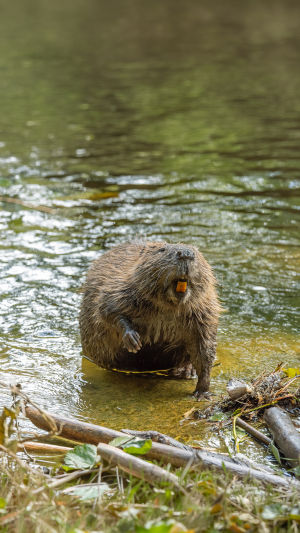
Wildlife does not always need remote forests or untouched countryside to survive. Sometimes, nature finds room to flourish beside busy roads, railway lines, and residential buildings.
A remarkable nighttime photograph from Poland captures this unexpected relationship and has earned recognition in the 2026 Rewilding Europe Award. Taken by photographer Jan Wieczorek, the winning image shows beavers living along a river in the city of Olsztyn, offering a thoughtful reminder that urban spaces can also support thriving natural habitats.
<h3>A Winning Photograph from Poland</h3>
Titled Urban Beavers, the photograph presents a group of beavers gathered in a wetland area after dark. In the background, nearby housing development reveals how closely their habitat sits alongside the expanding city. Wieczorek has observed the beavers for approximately 15 years, giving him an unusually long view of their surroundings and daily activity. Rather than presenting wildlife as something separate from modern life, he chose a composition that places the animals and the built environment within the same frame.
The photograph received the 2026 Rewilding Europe Award, a special category within the European Wildlife Photographer of the Year competition. The award is organised in partnership with Rewilding Europe and the German Society for Nature Photography. It recognises photography that draws attention to nature recovery and the possibilities for people and wildlife to share landscapes.
<h3>How Beavers Support Their Habitat</h3>
The beavers in Olsztyn are more than an interesting subject for wildlife photography. Their activity also contributes to the surrounding wetland. By building and maintaining dams, beavers influence how water moves through an area, helping create conditions that support other forms of life.
According to Rewilding Europe, their dams help restore local water balance, improve water quality, and encourage greater biodiversity. The wetland they have created provides habitat for other species while contributing to the natural processes that keep the landscape functioning.
The river runs through a developed part of Olsztyn, where roads, railway crossings, and new residential buildings form part of the surrounding environment. Despite the construction nearby, the beavers continue to occupy the area. Support from local residents and city authorities has also contributed to their continued presence.
This example shows why urban planning and environmental awareness matter. Natural spaces do not always need to be completely separate from human activity. With thoughtful management, waterways and wetlands can remain valuable habitats even in growing cities.
<h3>Other Photographs Highlight Nature Recovery</h3>
The 2026 award also recognised several photographs that present different aspects of wildlife recovery across Europe. Each image tells a separate story, from the return of native species to the value of restoring natural landscapes. Christoph Kaula's Managed Revival was named runner-up. It focuses on the European hamster in Germany, where conservation programmes use breeding, genetic research, habitat care, and population monitoring to support recovery.
Silke Hüttche's The Call of the Eagles offers a different perspective. It features two white-tailed eagles perched in trees at Anklamer Stadtbruch, a large natural area in Germany. The wetland was rewetted following a storm surge in 1995. Hüttche's photograph highlights how restored landscapes can provide valuable conditions for wildlife.
<h3>Why Wildlife Photography Matters</h3>
Wildlife photography can communicate conservation ideas in a way that statistics and technical reports sometimes cannot. A carefully composed image gives viewers a direct impression of an animal's surroundings, its behaviour, and the relationship between nature and human activity.
Jan Wieczorek's winning photograph offers a clear example of how wildlife and urban development can exist close together. The beavers of Olsztyn continue to thrive in a wetland surrounded by an expanding city, while their activity helps support the local environment.
Alongside the other recognised photographs, the image highlights the value of protecting habitats and giving nature room to recover. Its message is simple: healthy natural spaces can exist closer to everyday life than many people expect, and protecting them can benefit both wildlife and the communities around them.


