

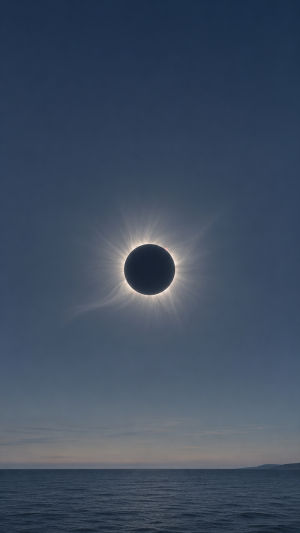
A total solar eclipse is a rare event that can transform an ordinary afternoon or evening into an unforgettable experience. On August 12, 2026, the Moon passed directly between Earth and the Sun, creating a narrow path where observers could witness the Sun disappear completely for a short time.
Parts of Greenland, Iceland and northern Spain were among the places offering a view of totality, while many other European locations experienced a partial eclipse.
<h3>Where the Eclipse Was Visible</h3>
The path of totality crossed a limited area of the Northern Hemisphere. Within this path, the Moon completely covered the bright face of the Sun for a brief period. Outside it, viewers could see only a partial eclipse, with the Moon appearing to cover part of the solar disk.
Greenland, western Iceland and northern Spain were among the main viewing destinations. The exact experience depended on the observer's location, as the duration and timing of totality varied along the route. In Iceland, the western part of the country offered opportunities to see the full event. Reykjavík was also within the path, although totality lasted only around one minute.
Spain attracted particular attention because the eclipse occurred close to sunset. Several northern areas, including León and parts of the surrounding region, were positioned to experience totality. However, the Sun was relatively low in the sky, making an unobstructed view toward the western horizon especially important.
<h3>Why Location Made a Difference</h3>
Not every place within the path offered the same viewing conditions. Greenland provided access to the eclipse in a remote setting, while Iceland combined accessible viewing areas with landscapes that offered wide horizons. Spain presented another option, with a broader range of towns and communities along the route.
Weather was an important consideration. Cloud cover can hide the Sun even when an observer is standing directly beneath the path of totality. Historical weather patterns suggested that parts of Spain had a better chance of clear skies than Iceland, although conditions on the actual day could never be guaranteed.
The position of the Sun also affected visibility. In Spain, the event happened near sunset, so buildings, trees, hills and other obstacles could block the view. A suitable location needed a clear western horizon, particularly for observers in areas where the Sun was already close to the skyline.
<h3>Understanding Total and Partial Eclipses</h3>
A solar eclipse occurs when the Moon moves between Earth and the Sun. The Moon blocks some or all of the sunlight reaching a particular area, depending on the alignment and the observer's position. During a partial eclipse, the Moon covers only a section of the Sun. The sky may become slightly dimmer, but daylight does not disappear completely. During totality, the Moon covers the entire bright solar disk for observers positioned inside the narrow central path.
This complete coverage is what makes a total eclipse especially remarkable. The surrounding sky can become noticeably darker, and the Sun's outer atmosphere, known as the corona, becomes visible around the Moon's silhouette. The period of totality is usually brief. For the August 2026 event, most locations experienced it for less than two minutes. That short window made preparation important, since a missed moment could not easily be recovered.
<h3>How to Protect Your Eyes</h3>
Watching a solar eclipse requires proper eye protection. Looking directly at the Sun during the partial phases can cause serious and permanent eye damage, even when much of its surface is hidden. Ordinary sunglasses are not suitable, regardless of how dark their lenses appear. Viewers should use certified solar viewing glasses or a handheld solar viewer designed specifically for direct observation. Products should meet the ISO 12312-2 international safety standard.
There is one important exception: during the brief period of totality, when the Moon completely covers the Sun's bright face, observers within the path can look directly at the eclipse without solar filters. Protection must be put back on as soon as any part of the bright Sun becomes visible again.
People using cameras, binoculars or telescopes need additional precautions. A suitable solar filter must be attached to the front of the optical equipment. Wearing eclipse glasses while looking through an unfiltered camera lens or telescope does not provide adequate protection.
<h3>A Simple Way to Watch Indirectly</h3>
People without certified solar glasses can still follow the partial phases using an indirect viewing method. A pinhole projector is a simple option that can be made with a piece of card containing a small opening. With the Sun behind the observer, sunlight passes through the hole and creates a small image on a nearby surface.
For future eclipses, the most useful approach is to check the path of totality, choose a location with a clear view and prepare certified viewing equipment in advance. A few practical steps can make a short astronomical event safer, easier to enjoy and far more memorable.


