

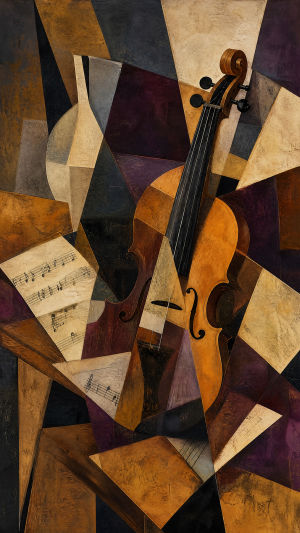
Hi, Readers! Standing in front of a painting, listening to a piece of music, or reading a poem can feel immediate and clear, yet also leave us with questions.
That tension sits at the center of a long debate in aesthetics: does art need explanation in order to be understood? A careful answer is no, not always.
Many works can be experienced directly through perception, feeling, and attention. At the same time, explanation and interpretation often deepen understanding by showing structure, context, intention, and meaning that are not obvious at first glance.
One important distinction is between experiencing art and interpreting it. A person may respond to rhythm, color, shape, tone, or narrative movement without any theory at all. That first encounter matters. It is not empty or inferior simply because it lacks commentary. In many cases, basic understanding begins there. We recognize sadness in a melody, tension in a scene, or balance in a composition before anyone explains anything. So if the question is whether explanation is always required for any understanding whatsoever, the answer is clearly no.
<h3>What interpretation does</h3>
Interpretation usually tries to say what a work means, how its parts fit together, and why certain features matter. It can connect details that seem separate, resolve ambiguity, and draw attention to patterns we might miss. In literature, interpretation may clarify symbolism, point of view, or narrative irony. In visual art, it may show how composition, reference, and historical context shape what we see. In music, it may explain form, motif, and expressive contrast. Explanation does not simply replace experience. Ideally, it returns us to the work with sharper attention.
Still, interpretation is not a single simple act. Different approaches ask different questions. Some focus on the creator's intention. Others emphasize the work itself, its public features, or the responses of audiences. Some stress historical setting, while others explore broader conceptual frameworks. Because of this variety, interpretation can illuminate art in more than one valid way. That is one reason people continue to debate works that remain powerful after repeated viewing or reading.
<h3>When art can stand on its own</h3>
Not every artwork demands verbal explanation. Some works communicate forcefully through form alone. A dance performance, an abstract image, or a short lyric can create understanding through pattern and feeling rather than clear propositional content. In such cases, asking for a full paraphrase may even miss the point. Art often works by showing rather than stating. Its meaning may be inseparable from the very way it is made. Trying to convert that into a plain statement can reduce rather than clarify.
There is also a risk in overexplaining. If every response must be justified by expert commentary, ordinary perception starts to seem inadequate. That would be a mistake. Viewers and readers are not blank until instructed. They bring sensitivity, memory, and practical knowledge to what they encounter. A strong artwork can meet them there. Explanation is most useful when it opens possibilities instead of closing them, and when it helps us notice what is present rather than forcing a rigid conclusion.
<h3>Why context still matters</h3>
Even so, some art becomes much more intelligible when we know its context. References, conventions, and genre expectations are not always transparent. A work may respond to earlier works, rely on symbolic traditions, or take shape within a particular social and intellectual setting. Without that background, a viewer may still feel something important, but miss layers of significance. Explanation can therefore be enabling rather than intrusive. It gives us access to meanings that are genuinely there but not immediately visible.
This is especially true when works are distant from us in language, custom, or historical setting. Interpretation can bridge that distance. It can explain why a gesture matters, why a form was innovative, or why a certain theme carried unusual force. In this sense, explanation is less a substitute for understanding than a path toward fuller understanding. It does not create the artwork's value, but it can help reveal it.
<h3>A balanced answer</h3>
The strongest position is a balanced one. Art does not need explanation in order to be encountered, felt, or appreciated at a basic level. Direct experience is real and significant. Yet explanation often helps us understand more, especially when a work is complex, allusive, or historically distant. Interpretation is most valuable when it remains answerable to the artwork itself and when it enriches rather than dominates our experience.
So, Lykkers, art does not always need to be explained before it can be understood, but thoughtful explanation can make understanding richer, more precise, and more rewarding. The best approach is to begin with your own attentive encounter, then welcome interpretation as a tool, not a command. Look first, listen closely, and let explanation deepen what you already started to notice.


