

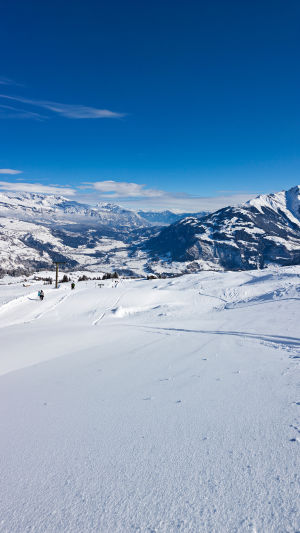
Climate change is forcing ski resorts across the Alps to rethink what a winter holiday should look like. In Laax, Switzerland, the response goes beyond producing more artificial snow.
The resort is investing in renewable energy, electric machinery and activities that can attract visitors even when snowfall becomes less predictable.
For travelers, that means Laax increasingly feels like more than a conventional ski destination. Snowboarding and skiing remain central, but hiking, biking and other mountain experiences are becoming equally important to its future.
<h3>Winter Is Becoming Less Predictable</h3>
Rising temperatures are particularly challenging for lower-altitude Alpine resorts, where reliable natural snowfall can no longer be taken for granted.
Laax benefits from high terrain, but it is still preparing for shorter winters and changing snow conditions. For the 2026/27 season, the main winter operation is scheduled to begin on November 28 and continue until April 11, although individual lifts always depend on weather and snow.
Early-season skiing can also be relatively flexible. An afternoon lift ticket in late November starts at around €60, with prices changing according to date and demand.
The broader strategy is to make the mountain attractive even when skiing conditions are not perfect.
<h3>Snowmaking Is Getting Smarter</h3>
Artificial snow remains part of the solution, but Laax is trying to reduce its environmental impact.
Its snowmaking system uses water without chemical or biological additives, while hydropower helps supply the energy needed to operate parts of the infrastructure.
Snow production is also becoming more targeted. Rather than covering every slope regardless of conditions, technology can help determine where additional snow is genuinely required.
This matters because snowmaking consumes both water and electricity, making efficiency increasingly important as Alpine winters warm.
<h3>Gondolas Move On Demand</h3>
One of the most unusual changes is a new generation of gondola technology.
Instead of continuously circulating every cabin, an on-demand system can dispatch cabins according to passenger needs. The idea is similar to calling an elevator rather than keeping every lift permanently in motion.
Resort chief Reto Gurtner has explained that the wider goal is to redesign mountain tourism rather than simply compensate for disappearing snow. His approach combines lower energy use with changes in transport, food, waste and year-round activities.
Electric vehicles and electric piste-grooming machinery are also becoming part of daily resort operations.
Laax
<h3>The Mountain Is Becoming Year-Round</h3>
Perhaps the biggest shift is happening outside winter.
Mountain biking, hiking, freestyle sports and family attractions are reducing the resort’s dependence on ski-season revenue. This diversification gives visitors more reasons to travel to the region during warmer months while providing the local economy with greater stability.
Nearby villages also offer a quieter alternative to the resort center. Falera, for example, retains a more traditional Alpine atmosphere and is connected by public transport, making it possible to explore without relying heavily on a private car.
<h3>Nature Remains Part Of The Appeal</h3>
The surrounding landscape is changing, but it is far from lifeless.
As snowlines retreat, different plant species are appearing at higher elevations, while wolves and lynx have returned to parts of the region. These changes show that climate pressure does not produce one simple environmental story.
For visitors, protecting that landscape is becoming part of the experience rather than an invisible issue behind the scenes.
<h3>Ski Resorts Need A New Model</h3>
No amount of technology can guarantee cold winters forever. That is why Laax’s approach is notable: it is trying to make the resort less dependent on a single season rather than simply defending the old model at any cost.
For travelers, the result is a destination where skiing still matters enormously, but where the future may depend just as much on what happens after the snow melts.
The Alps are changing. Laax is betting that successful mountain tourism will have to change with them.


