

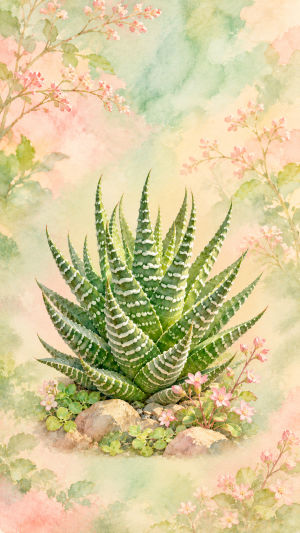
Welcome, readers. Most houseplants give you solid green leaves that block light and get on with the job.
Haworthia cooperi does the opposite. Hold a rosette up to a window, and the leaf tips turn clear enough to read a shadow through, and that see-through look is not a trick of the light. It is built into the tissue.
<h3>The window is real tissue</h3>
The transparent part of a Haworthia cooperi leaf is called a leaf window, and it sits right at the rounded tip. Under it, the green photosynthetic tissue is pushed deep into the leaf rather than spreading across the surface as it does in a normal plant. That arrangement lets light pass through the clear tip and reach the chlorophyll buried inside. A single leaf is only about 1 to 2 cm across, so the whole window is small, but the effect is strong.
<h3>Why the plant hides its green</h3>
Haworthia cooperi comes from the Eastern Cape region of South Africa, where it grows half-buried in gritty soil and gravel. Only the top of each leaf sits above ground. If the green tissue were on the surface, full sun would scorch it. Burying the chlorophyll and covering it with clear tissue means the plant can harvest light while keeping the delicate parts underground and shaded. You see the same strategy in Lithops, the stone plants, which also sink into the ground, leaving a translucent top exposed.
<h3>Water is what makes it clear</h3>
The window itself is mostly water-filled cells with very little pigment, which is why it looks glassy rather than milky. That clarity depends on the plant staying well hydrated. A Haworthia cooperi that has gone weeks without water will start to look dull and slightly cloudy at the tips, and the window shrinks as the cells lose turgor. Give it a soak and the clear look comes back within a few days. That is a handy diagnostic: if your plant's windows go grey, check the soil before you assume it needs more sun.
<h3>Getting the light right indoors</h3>
Here is where people get it backward. A see-through leaf does not mean the plant wants blazing sun. Haworthia cooperi grows best in bright, indirect light, and a south-facing windowsill in summer will often turn the rosettes reddish-brown and tighten them up. Aim for 4 to 6 hours of soft morning light, or use a sheer curtain. Water roughly every 2 to 3 weeks in spring and summer, letting the potting mix dry out fully between drinks, and cut back to once a month in winter. Use a gritty mix, something close to 50 percent pumice or coarse sand, because the plant's roots rot fast in dense soil.
<h3>Do not treat it like a cactus</h3>
The most common mistake is lumping Haworthia cooperi in with desert cacti and giving it full sun and long dry spells. It is a summer-growing species from a region with more rainfall than the true deserts, and it wants a little more water and a lot less glare than a cactus. The other slip is repotting into regular potting compost, which holds moisture too long. If you repot, go up to one container size at most, since these plants prefer to be slightly root-bound.
So the next time you see one of these rosettes on a shelf, hold it up to the light and look through the tip. What you are seeing is a plant that solved two problems at once: hiding its green from the sun while still letting light in, and it will reward you for keeping the soil gritty and the light gentle.


